26 June 2015

D&D 30-Day Challenge: Day 2 - Favorite PC Race

Favorite PC Race.  Well, I'm afraid my answer for this one is going to be fairly boring - Human.  That said, I've played all the classic PC races from the BECMI Dungeons & Dragons game, as well as a few from AD&D or newer editions that weren't canonical or playable back in the old days.  I guess I should elaborate a bit, since just the bare answer wouldn't make for very interesting reading.

So, when I got into D&D, there were really only four PC races to choose from, and in that case race as class was a thing.  For those who don't remember this time long ago, what that means is that Humans could choose a class- Cleric, Fighter, Magic-User or Thief.  Demi-Humans, that is Dwarves, Elves and Haflings treated their race as their class.  There were no Dwarven Clerics or Halfling Thieves in the BECMI rulebooks.  Now, such things would be added later by the Gazetteer series and already existed in Advanced D&D, but we're talking about the game I played when I started playing D&D - and that's the Mentzer BECMI rules.  BECMI stands for Basic, Expert, Companion, Master, Immortal.  These were the five boxed sets that made up the whole of the rules for this "edition" of Dungeons and Dragons.

So... as a Human, you could play the four classes.  If you chose Demi-Human, you were what the rest of the adventurers of your race were.  Demi-Human classes were kind of paragons of what it was to be that particular race.

Dwarves were fighters with much better Saving Throws and some pretty neat abilities.  Dwarves could see in the dark.  It was called Infravision in those days, and I still call it that now out of stubborn grognard habit.  So, Dwarves saw heat out to 60', allowing them to function in the dark.  They also spoke dwarf, gnome, goblin and kobold in addition to Common and their alignment language.  They could detect stone traps, slopes, new construction and other details about stonework.  You know, Dwarf stuff.  Back in the 80s we did not yet have the Scottish Dwarf stereotype, but the rest of the Dwarf stereotype was already alive and well.  I enjoy playing Dwarves, they are hardy and their abilities give some good RP fodder, though they tend to be very Tolkien Dwarf- which is a feature, not a bug, if you grew up playing like I did.  Lots of fun, but not my favorite.

Elves were basically Fighter/Magic-Users.  The orignal Elf in the 1974 rules had to choose whether to function as a Fighting Man or a Magic-User each day, and could only use the abilities of one or the other during that day.  The Elf of BECMI D&D did both of them at once!  Your Elf could wear plate armor and cast Magic Missiles!  Elves had less hit points than Fighters, and required more experience points than any other class to make levels, but they were amazingly versatile.  On top of being able to use any weapon or armor and cast Magic-User spells, elves also had Infravision, extra languages, and could detect secret or hidden doors of any type 1/3 of the time.  Oh, and they were immune to being paralyzed by ghouls.  Lots of fun, Elves.  A very do-everything class, but the XP toll was heavy.  Enjoyable, but again, not my favorite.

Halflings.  I feel like the BECMI Halfling is overlooked a lot.  Oh, and I have it from Frank Mentzer himself that they're HOBBITS, damnit.  Anyway, these little guys have the most incredible Saving Throw progression in the game, they have an AC bonus versus large creatures, the natural ability to hide nearly perfectly out of doors and fairly well indoors.  They also get a bonus on individual initiative and on missile attacks.  There's a lot of great abilities here, and a lot of play value in creating a Half- er, Hobbit PC.  A very, very entertaining choice and a surprisingly hardy little character- but not my favorite.

I have to go with plain old boring Humans.  Why?  Well, most of my PCs are human because I identify most readily with humans and, as my current PC Linhardt of Quasqueton proves, I like an underdog.  Humans (in most game worlds) are forging their own way in a world populated by races that can see in the dark, or are naturally magical, or have skills Humans lack, and still the Humans prevail on sheer will and Chutzpah.  As a Human I can play my favorite character class- to be revealed in the next post.  Humans tend to get along with all the other PC races, where some of the PC races don't always like each other in many game worlds.  I enjoy the familiarity, yet versatility of the bog-standard Human.  May not have Infravision, or an AC bonus, or know jack about stonework- but my favorite PC race.

25 June 2015

D&D 30-Day Challenge: Day 1 - How you got started.

So, I see this thing on Facebook about the Dungeons and Dragons 30 Day Challenge. Looks kind of interesting.

I've been a gamer since the summer of 1986.  That's 75% of my mortal existence at the time of this writing.  It's the hobby and interest that defines me, right down to things I love to do with my kids and the subject matter of the Masters Thesis I am currently writing for my MA in Military History.  Maybe it would be an interesting exercise to go through the D&D Thirty-Day Challenge for my own reminisces as well as the enjoyment of anyone out there in Internet Land who would find it of interest.

In 1985 I was 10 years old and had just relocated from Round Rock, Texas to Temple Terrace, Florida.  My mother was looking for a fresh start, and we pulled up stakes and and went to Florida where her sister Carrie and her husband and their newborn were living.  My uncle Gerry was a programmer at IBM and a audiophile with a taste for the Beatles, and my cousin Kenny a tiny spud of a baby who was vaguely amusing to me.  I was terribly put off by the move- all my friends were being left behind, I didn't know anyone, it wasn't even my state.  My sole consolation upon arriving was to find that my favorite cartoon that I'd only seen aired in my grandparent's market in Lake Charles, LA also aired here - Tranzor Z.  Our first day in Florida, I tuned in.  As Tranzor Z ended I was fascinated by this other show I had never heard of - Robotech.  The episode I saw first was one of the final "New Generation" storylines of the 85-episode series, in which Scott Bernard and his Freedom Fighters find the city of Denver preserved beneath ice.  I couldn't take my eyes off it. 

The year we spent in Florida reinforced some things I already loved - GI Joe, Transformers, Voltron - and introduced me to some new things - Robotech, MASK, and my first glimpse of Advenced Dungeons & Dragons.  Although I cut my teeth on Mentzer D&D Basic, the first books I ever paged through belonged to the older brother of a school friend named Eric who lived across the apartment complex from us.  He had the AD&D core books in his room, and I was immediately fascinated by them.  I had heard of D&D of course, most kids my age had.  We watched the D&D cartoon, and some even had a few of the LJN D&D action figures like Strongheart, Warduke or Peralay.  There were a couple of D&D carts for the Intellivision... but books?  What could they be for?  Sadly, Eric's brother and his friends were about as enthusiastic about showing us as Elliot's brother Michael's friends in E.T.  You can't just join any universe in the middle.  I had to content myself with my other interests, like my Vectrex and Transformers, until we moved back to Round Rock the following summer.

Returning to Round Rock was something of a sort-of victory for me.  I was home, back in the town I considered my hometown- it was where my mom's parents lived with some of my aunts and uncles, and the town where I had the most memories and roots.  Mom and I had moved there the first time in 1982 after I completed the first grade in Humble, TX.  I made a lot of good friends at Robertson Elementary from '82-'85, and I was looking very forward to picking those friendships back up when we got back to Round Rock... only we moved to the other side of IH-35 and I ended up at Chisholm Trail Middle School instead of C.D. Fulkes, where everyone I knew went.  I was back to being the new kid with no friends.  This kinda sucked.

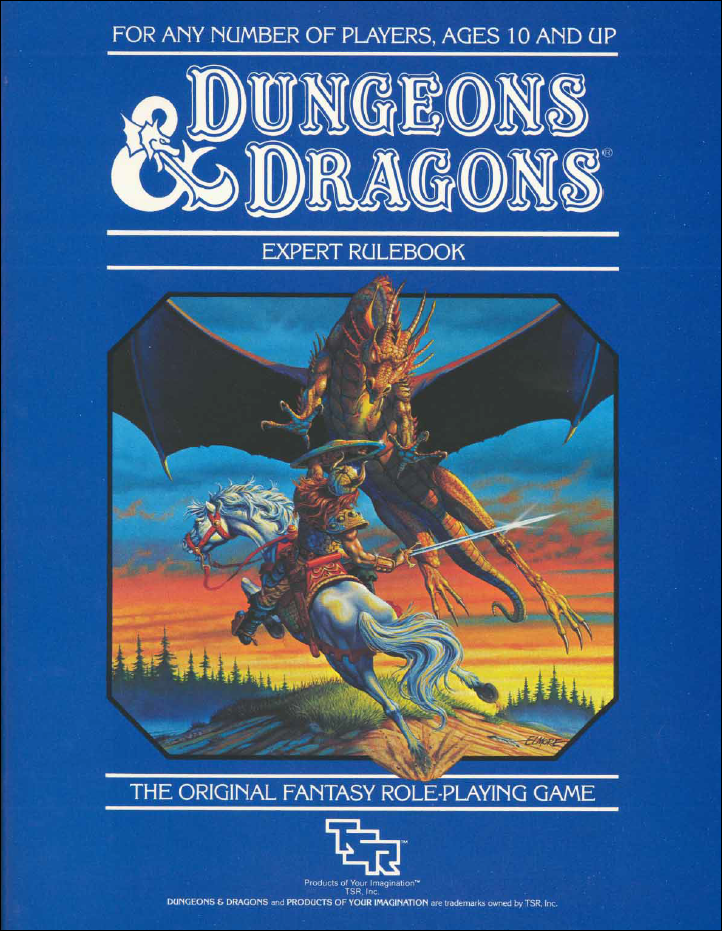
Almost immediately, I met Daniel Varner.  Daniel was a fellow science fiction nerd, and had to wear a brace that kept his knees apart by about a foot, making his locomotion a Cowboy-like gait where one leg swung forward followed by the other.  In Boy Scouts he picked up the nickname "Jock Itch" for this particular factor.  Daniel and I became fast friends, and he invited me over to his home to hang out after we met at the park just off Chisholm Valley Drive that would later become the second incarnation of Drakenroc, my Amtgard LARP park.  Along with Jim "Cookie" Cook and a few others, we delved into the realm of Dungeons and Dragons for the first time during the summer of 1986.  Daniel had the Mentzer Basic and Expert rule sets, and he started all of us with our first characters at 4th or 5th level.  I remember opening the D&D Expert Rulebook, the blue one with the mounted fighter charging the dragon, for the first time.  The illustrations are what pulled me in immediately.
 
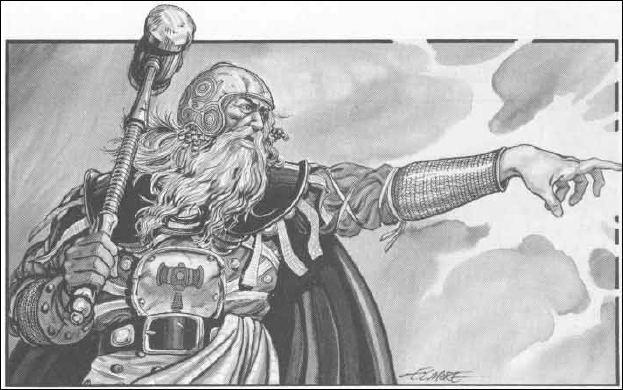
I will always owe a debt of deep gratitude to Larry Elmore, who I had the chance to meet recently, for the art that set the hook, and to Frank Mentzer, who I also got to game with earlier this month, for penning the version of D&D that remains my favorite to this day.  Two illustrations in particular remain so vivid in my mind that I can close my eyes and recall them in detail even today.  The first was of a Cleric casting what I assume was the Speak With Dead spell, the second was the class illustration for the Cleric class itself a few pages earlier.  I guess the book must have opened to the spell descriptions.  This book had me enthralled in a way only possible before by books on things like UFOs and the Loch Ness Monster.  I loved reading about the strange and the paranormal.  I loved reading The Hobbit.  This was somehow a book you could... play?  And thus my first, short-lived character, a Cleric, was rolled up.  With the toss of that first 3d6 (in order) a journey began that has not yet ended and God willing won't for many years to come.  It is a journey that has been shared with countless friends along the way as well as my wife and my son- and soon, my daughter, when she's a bit older.  The collaborative storytelling that is the Roleplaying Game soon captured my imagination like nothing before had, and I found myself turning to reading even more as a favored pastime.  I devoured books from the CTMS library and Round Rock Public Library on everything from mythology to the middle ages to ghosts to spacecraft.  I discovered that Conan was more than an Arnold Schwarzenegger film.  D&D soon led me to Marvel Superheroes, Star Frontiers, and Gamma World.  My mom's co-workers at Eaton found out I was gaming, and gifted me with Traveller, Cyberpunk 2013 (brand new!) and 2300 AD books.  I scraped together my own money and purchased the first RPG I ever bought for myself just after my birthday in 1987- Palladium's Robotech RPG and a set of red Koplow dice in the extended tube that came with 3d6 and 2d10.  Then came Palladium Fantasy, GURPs, Paranoia, Star Wars D6, FASA Star Trek, Call of Cthulhu, Elfquest and Pendragon- all before I was a High School Freshman.

Gaming became such an important part of our lives that it was the bulk of our scouting weekends.  Much to our scoutmasters dismay, we'd rush to set  up camp and get dinner on the fire so we could break out the D&D or Traveller books and have adventures.  We even played a mini-campaign at Lost Pines Scout Camp, and somewhere out there my second Cleric, Brother Maynard, is still running...  Daniel's group played every day after school for all of middle school when we could, and most Saturdays.  We were kids, with munchkin tendencies, and I got my second character, a Magic-User, into the high 20s level-wise before he was killed by the black dragon we had managed to subdue...  while strapping on its feed-bag.  What do you want, we were 13?

Dungeons and Dragons and other RPGs gave us misfits a place to fit.  When we weren't athletes or popular folks we could always sit down at a kitchen table with others of our kind and toss dice, creating stories together that were just as good as any book or movie.  We could cease to be middle school students and be great warriors, mages, clerics or thieves.  Movers and shakers in the Known World, delving dungeons from which lesser mortals never returned.  And that made for a childhood that was completely badass.

I can honestly say thanks to this hobby I read more, I learned more math - any Traveller player who wanted to calculate interplanetary journey time had to know how to square root things - I devoured knowledge in all its forms and learned creativity and problem-solving.  I learned people skills, how to improvise dialogue and voices, how to plan for contingencies...  I wouldn't trade it for any other childhood.  I grew up in the 80s, we had D&D, great cartoons, great video games and the best music ever.

My mug is raised to Gary and Dave for giving us the game, Frank and Larry for making it something that immediately grabbed me and pulled me in, and especially to Daniel Varner, wherever you are, for handing me my first D20.  Cheers, guys.  And as I have done so much in the past, I will continue to spread the game and hopefully the love of the game as long as I'm able.


23 June 2015

Classic TSR: Star Frontiers

Welcome to the Frontier.
 
Star Frontiers.  This was not the first science fiction RPG, nor was it TSR's first sci-fi RPG - that honor belongs to Metamorphosis Alpha, which I will cover in another post.  Star Frontiers wasn't even *my* first sci-fi RPG, that was Traveller.  SF came second, just before West End Star Wars and Robotech.  So instead of talking about what SF wasn't, let's talk about what it WAS.

Star Frontiers came out in that wonderful era of proliferation that I consider my personal Golden Age of RPGs.  The 70s set the stage, and the 80s took the show to a whole new level.  The first half of the Al Franken Decade saw TSR release so many games that are seminal to my own experience.  During this time, there  were advertisements for TSR games in comic books and even on television.  Included here are Star Frontiers ads from a comic, and from broadcast TV.

This was the time that gave us Gangbusters, Marvel Superheroes, the BECMI revision of D&D, and revisions of Boot Hill, Gamma World and Metamorphosis Alpha.

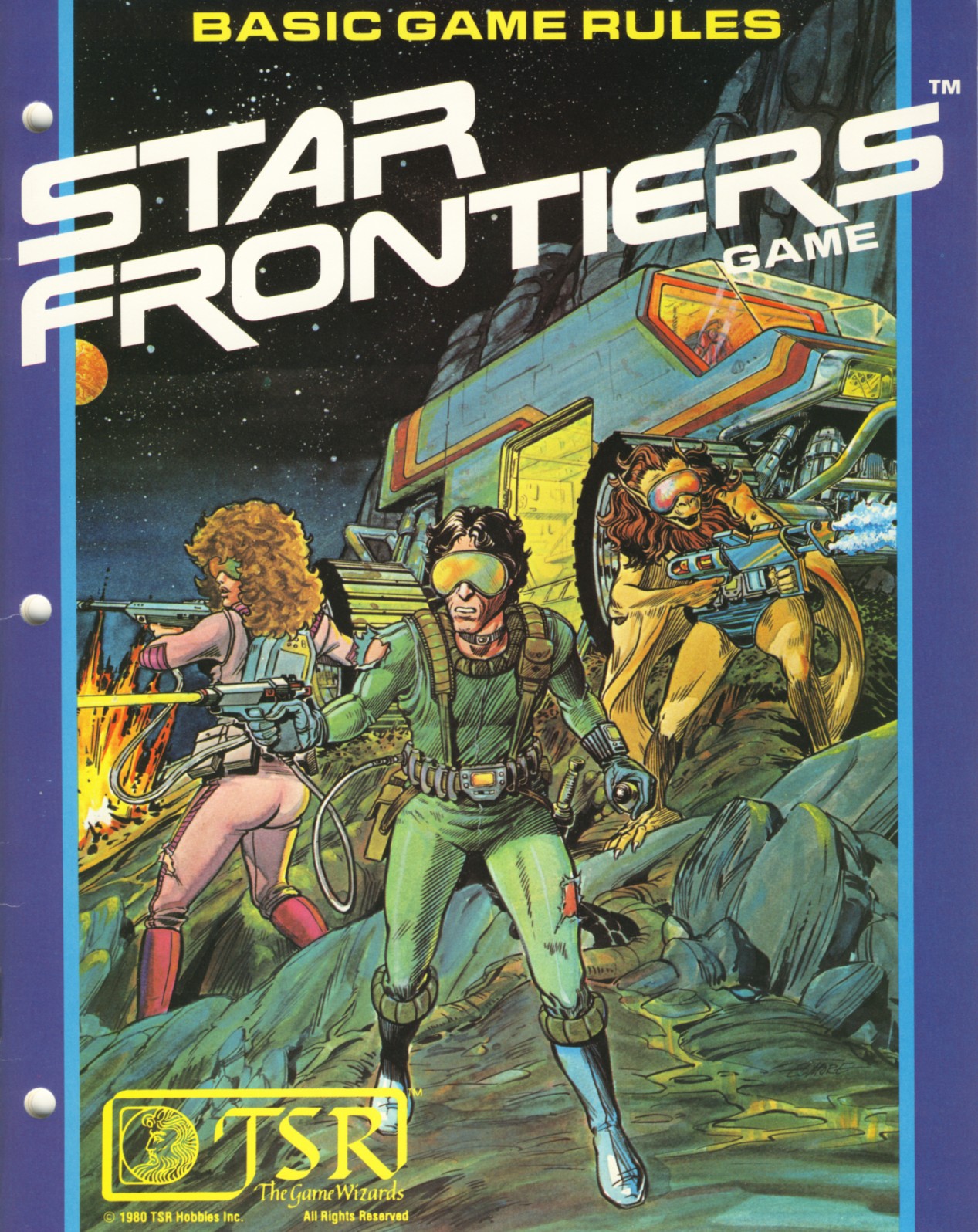
Star Frontiers is graced with a beautiful cover painting by Larry Elmore.  In this painting one can see the promise of the Star Frontiers game brought to fiery life.  Two human adventurers, one male and one female are joined by a Yazirian adventurer escaping the remains of a crashed craft under a bright sky included large, colorful moons (or is the world they're on the moon?) and a star-filled sky.  One can imagine these survivors clambering down the escarpment they are standing on in an attempt to find shelter.  The Yazirian's open-mouthed expression and leveled weapon indicate he may have spotted something threatening off to the group's left.

  In other words- the painting makes me wanna play.  The game itself came in a box, the original box was blue, the reprint maroon.  Both games had the same rules and contents, with slightly altered trade dress.  The boxes contained the standard saddle-stitched books.  The Basic Rules book was a thin 16 pages, the Expanded Rules 64 pages, plus the Crash on Volturnus module.  Also included were a pair of maps and some cardstock counters for use in adjudicating combat encounters.  Oh, and a pair of 10-sided dice and (depending on printing) a crayon.  Even though the first set of dice I bought for myself were inked (Koplow tube, red crystal with white ink, with a tens ten and 3d6, King's Hobby Shop,1986) I had received some older dice with hand-me-down sets from friends and the crayon, once I figured out what it was for, represents nostalgia to me.  Hell, I still have the twenty-sided d10s from my FASA Star Trek sets, although they're pretty much round now.

  The Basic Rules books shows that Star Frontiers is a d100-based system.  TSR was really all over the place in game systems, as this d100 system was nothing like the d100 system Jeff Grubb created for Marvel Superheroes (although Zebulon's Guide would later make them very similar) and was not similar to D&D as Metamorphosis Alpha had been.  Ability scores were expressed as numbers that could be rolled against on d100.  The races of Star Frontiers are in here- Humans, Yazirians, Dralasites and Vrusk.  A basic system of combat and RP is presented.  I'll be honest, I never used the basic rules, we always used the expanded rules- they weren't that complex.  64-page rulebooks being "expanded" seems pretty quaint these days.  There was one idea here that later inspired me to create campaign ideas - the standard equipment pack.  Much like the Fast Packs from B4: The Lost City, here was a way to eliminate start-of-campaign shopping trips.  Every player got this basic kit, plus 10 credits.  Note, no weapons were included except a single tangler grenade.  So, why did this simple addition inspire me to write?  It's right there in the game title.  The Frontier.  The Frontier of what?  What if the Frontier was so far from the homeworlds of the major races that it was nearly a one-way trip.  Folks down on their luck or just looking to strike it rich head out to the Frontier to seek their fortunes.  Some can barely afford their passage, and upon arrival after a trip of (weeks?  months?) in cold sleep to be given a standard issue pack of gear and released into a massive receiving station where PanGalactic and other Megacorps have hawkers trying to recruit new blood into their organizations.  With 10 credits to their name plus the pack on their back, the PCs must make their own way in a newly established corner of space.  Welcome to the Frontier.

  The Basic Game Rules booklet has a different piece of cover art, the same three adventurers (I think) with a vehicle called an Explorer.  Explorers are really large vans, apparently painted with racing stripes in 70s color schemes designed to rove across unexplored worlds.  These vehicles also give me great imagination sparks - think of living in one with your contacts for weeks at a time, rolling across lands no sentient has seen, searching for adventure in any form.  That's what adventure gaming is about, folks.

  The Expanded Game Rules book is the version of SF I played.  Now, I've said how inspiring the Larry Elmore cover art is - but the interior art by Jim Holloway is every bit as evocative as well.  There is a particular illustration of a man fighting with a sonic sword in one hand and a shock glove in the other.  My mind parsed this as a swordsmanship style in the Renaissance fashion, where some schools might teach the use of the cloak as a weapon, the cloak or parrying dagger is here replaced by the electrifying shock glove.  One illustration, hours of inspiration.  Not only did this end up being the primary fighting style of some space pirates in my SF games, it survived into the 2010s as the swordsmanship style of the House of Dencourt in my MechWarrior campaign.

The expanded rules include "classes" in the form of PSAs, or Primary Skill Areas.  These are Military, Technological and Biosocial.  Each allows a player to choose one skill from within their PSA, and then a second skill from any PSA.  The skills in Star Frontiers are a bit of all-over-the-place.  Weapon skills apply to a single class of weapons, like Beam Weapons.  Other skills, like Computer, have multiple subskills with different mechanics and success chances.  Conspicuously absent from the skill lists are any sort of starship skills.  One of the often-cited criticisms of Star Frontiers was that there were no ship rules in the original set, these came along in the Knight Hawks box later.  There was a short bestiary of monsters, many of which can be found on Volturnus, the planet introduced in the included module and fleshed out in a following module series.  This was perhaps part of why space combat and space ships weren't covered- it seems the concept of Star Frontiers was that the characters would reach new planets by "starliner" and do their exploring groundside.  I did get a bit annoyed with the term "starliner."  Calling a ship a "liner" implies established routes, and the PCs being on their way to Volturnus, mysterious unexplored world.  Why would a shipping line go to an uninhabited planet?  Well, I have really given it some thought and realized that when they say "starliner" they really mean any ship chartered or otherwise since the PCs who, by the design of the game, can't own or operate a ship under these rules.  Now, this might seem a bit counter-intuitive for a sci-fi game, but Metamorphosis Alpha didn't have such rules, either.  In fact, those PCs didn't usually know they were on a ship.  Contemporary games like Traveller and Space Opera had spaceship rules, so... it's your call wether you think TSR was criminally negligent in leaving out spacecraft rules or not.

  I won't give up any plot points on the first module, Crash on Volturnus, other than what the title itself gives away.  The PCs are involved in a crash on the titular unexplored world, and must make their way with only the things they could scavenge.  It's a lot of fun, and includes many old school concepts like random encounters and overworld map hex-crawling.  A good introduction to Star Frontiers, and a great example of how a sci-fi game can function without ship rules.


  The rest of the box, maps and counters, shouldn't be discounted.  A lot of TSR games came with similar things- the map of Lakefront City in Gangbusters, of New York in Marvel Superheroes- all these were props that could help visualize the action.  The maps included in Star Frontiers have a spaceport city and a spaceship interior, perfect for many adventures.  Pirate attack on a "liner"?  Check.  Chasing a thief who just stole your parabattery through the streets of a port city?  Check.

  I see that I've written a lot, and said not nearly enough about the game.  Wow.  The system is definitely a product of the 80s, but it's fast and serviceable.  The alien races are truly alien, and not just humans with bumpy foreheads.  Yes, you kind of need the Knight Hawks boxed set for a "complete" game in the sense that the PCs could own and crew a ship, but there's plenty of adventure just within the Star Frontiers boxed set, or the Alpha Dawn reprint.  The Star Frontiers rules can be gotten from HERE.  Check them out.  You won't be sorry.  Grab some d10s, jump in your 70s-painted Explorer, and boldly go into an Elmore space landscape with your trusty Dralasite sidekick.

11 June 2015

BEST. CON. EVER.

  So most folks that know me know that in addition to a player and a GM/DM, I consider myself a student of RPG history.  I've read Designers & Dragons, I've read Playing at The World, I've read Of Dice and Men, I've read The Fantasy Role-Playing Gamer's Bible and I look forward to the new Gary Gygax Bio Empire of Imagination.  It is from this passion for RPG history that led me to resolve to make a pilgrimage of sorts to Gary Con.  I'd read about the turnout at Gary Con, and the guest list, and thought that I'd want to attend in the next couple of years and rub elbows with the authors and illustrators of my lifelong hobby.  Then I found out Gary Con was coming to me... sort of.

  Thanks to my new friend Dennis Sustare, now 1st Lieutenant in Her Majesty's Home Guard, I found out about North Texas RPG Con.  Dennis is a D&D luminary himself, having created the Druid class and penned not only his own games but supplements for many others.  He's also credited with quite a few amazing ColecoVision games along with other TSR alumni like Lawrence Schick, Jannell Jaquays and others.  Dennis told us of NTRPGCon, and I talked Mary into letting me go.  I took some days off work, and rolled to the con with Bobby, Ed and Scott.  Dennis had gone up a day before us, and we were joined in Dallas by Aaron and my old HS friend Shawn, who had introduced me to Dragonlance about 24 years previous.

  Walking into the hotel, we immediately saw two large NTRPG logos, one for this year and one for 2014.  We were in the right place, all right.  The logo is designed by Jennell Jaquays, and depicts a dragon with a Texas-flagged shield.  We knew we were in the right place.  Everywhere one looked, one saw gamers and game tables.

  The long and the short of it is this: This was the single greatest con I have ever attended, bar none.  Unlike ComicCons and Fan Days and other endeavors, I was not spending hours and hours standing in lines waiting to pay $50 for autographs.  This was a GAME con, and I spend my time gaming.  Too much time, if there is such a thing, but more on that later.  The guest to attendee ratio was nothing short of incredible.  I told a friend on Facebook that you couldn't throw a kobold and not hit at least two artists or authors.  It was like walking through a TSR Reunion.  Lawrence Schick was over here, Jeff Grubb was over there, Jeff Dee was casually chatting with Larry Elmore and DARLENE.  Name a name in early gaming, and if they were still drawing breath, they might just be in the building.  Steve Perrin, Steve Marsh, Steve Winter... lots of Jeffs and Steves... but everywhere you looked was a yellow badge or a custom NTRPGCON shirt with the name of a luminary from the golden age on it.

   So... what happened?  Glad you asked.  I got to meet some of the folks who made my early years of gaming awesome.  The Red Box from the BECMI set was what I cut my teeth on in 1986, and I got to meet, talk to and game with Frank Mentzer who gave me some great DM advice.  I got great coversations, autographs and photos from both Frank Mentzer and Larry Elmore who were together very much responsible for my lifelong passion for gaming.

  This trip was my gift from Mary to celebrate my 40th Birthday, which occurs later this month.  She got a cruise, I got NTRPGCON.  Now, as much as I love cruising... I think I got the better of the deal.  I invited a group of folks, and those that could make it showed up.  Bobby and I were beaten to the con by Dennis, and we were joined there on Thursday by Aaron, who lives in DFW.  We jumped into our first game- my first AD&D Tournament.  From there it was wall-to-wall gaming for four days.  Here's an overview of the games I played, and I'm not going into too much plot detail so as to avoid spoiling the scenarios that the DMs might want to run later.

THURSDAY
1. AD&D Tournament with DM Bill Barsh.

  Bill Barsh of Pacecsetter Games was our host, and I knew we were in trouble when he placed a tablet facing us in front of his DM screen that read "DEATH BY BARSH 3:30" and started counting down.  This was no home D&D game, this was a tournament, and that meant we were on the clock, on our guard, and in deep, deep kimchi.  There was a lot of bickering as players unfamiliar with one another had completely varying ideas of how to pursue the goal.  There was a refreshing amount of problem solving rather than straight hack-and-slash.  THIS was what old D&D was as far as puzzles and traps that so often fall by the wayside in modern gaming.  That said, there was very little roleplay since it was a tournament, and the point was to live long enough to gain the goal with as many party members alive as posisble.
  Yeah... about that...  it was a TPK.  Total.  Party.  Kill.  We died a lot.  Thing is... we had A BLAST.  We also came in second overall.  Not too shabby for a pickup team on their first tournament.

HIGHLIGHT:  Getting to see the Thief who spend the whole damn game invisible be the last PC standing and trying in vain to avoid inevitable death.  I almost cheered.  I know that's mean, but sitting out of every combat to preserve invisibility kinda boned the party in a few places.  Clever, but it's a team tournament...

2. Frank Mentzer's Ad-Lib Dungeon.

  OK, this was just awesome.  Frank asked us each to contribute two items from any gaming experience or book we've had, and he'd turn them into a D&D adventure.  We ended up starting a quest to find a Heartstone for the King, being waylaid by Venger who told us he would allow us to pass (and live) if we brought him three extraordinarily large eggs.  That's when we went on OPERATION: SIDEQUEST and came across carnivorous apes riding ostriches that were playing some sort of polo/soccer game while Eric the Cavalier hung, unresponsive, from a tree.  We managed to pilfer an egg from the ostrich pens, but were forces to watch a masterful Magic-User PC absue the magic system in wonderful ways to sneak his way into the nests of chained velociraptors to steal the remaining eggs we needed to appease Venger...  Yeah, this was pretty damn cool.  Cool indeed.

HIGHLIGHT: After the game Bobby ran into Frank Mentzer, who was bragging on his roleplaying ability to Bill Webb and Tim Kask.  Bobby will be insufferably pleased with himself for the rest of his life.

FRIDAY
3. TOP SECRET with Merle Rasmussen.

  Another chance to game with an author.  Merle Rasmussen turned out to be a total hoot, and his adventure had a great twist we never expected in a spy game.  There were a couple of cute anachronisms due to adapting a Cold War module to modern day, but we had a great time.  The group gelled well, and we even managed to figure out the premier trade good for the third world area of the globe in which we were operating.  Toilet paper.  Everyone loves toilet paper.  $50 worth of TP in the right part of the world can get you a few AK-47s and some dynamite.  Important life lesson.

HIGHLIGHT: Being reminded we were on a recon operation by our sole female agent while we were gearing up with assault rifles, explosives, and handguns...

4. RECON! with Dennis Pipes.

  I played a lot of Revised Recon! in high school.  I'd not played since 1993.  Little did I know this was the original Recon! game that predated my experience with the Pallaium revision.  This one is pretty hard to talk about at all due to the plot twists, but it was a ton of fun.  We were operating in Laos, and... well... damnit.  I could tell you, but I'd have to kill you.  Thanks to good experience on the part of the players and some familiarity with infantry tactics and COIN, we did OK... at least some of us made it out...  I would eagerly play this earlier version again.  In fact, I'm hoping to score a slot in Dennis Pipes' The Morrow Project event if he runs it next year.  I miss crunchy military post-apoc roleplay from the 80s.

HIGHLIGHT:  Aaron Murphy's heroic death.  Both of them.

5. Battletech with Gary Oliver

  This event was pitched as MechWarrior 1e/Battletech 2e.  My sweet spot.  Well, it turned out to be straight Battletech, but it was OK.  I got to play a Russian brother in a Hunchback, whose brother also played a Hunchback.  We hit all the Battletech high points - there was a Death From Above, there were missiles flying, overheating, annoying hovertanks, the whole schmear.  The best part was for a change I was just playing my 'Mech, not the entire OPFOR.

HIGHLIGHT:  The game master's son, Gavin, was gifted with a Royal Dragoon Guards unit patch to welcome him to the MechWarrior community.  He said he was going to put it on his school uniform...

SATURDAY:

6. Traveller with Mike Kelly

  I can only describe this game as high-powered.  We were all SOC A knights and dames, and we were wealthy and at ease at our hunting resort as the game opened.  It got awsome from there.  Mike Kelly managed to take a huge chunk of Traveller metaplot and make it into a morning's gaming session.  It was pretty damn awesome to be honest.  I've always loved Traveller, and the GM definitely highlighted the versatility of the Traveller system for us.

HIGHLIGHT: Mike telling us at the end of the game what he'd done with the plot, and my mind being blown.

7. Star Trek with Corbett Kirkley

  OK, aside from Corbett Kirkley sounding like the name of an inventor of self-aware probes that will later return and mistake CAPT James T. Kirk for their daddy... this game kicked a whole lot of ass.  See, what the GM did was innovative and so amazing we're all planning to do something similar when we get home.  The table was strewn with Star Trek props.  There were action figures.  The character sheets were foamcore squares with photos of the characters on the front, and the stats on the back with backgrounds color-coded to the uniform color of the character.  We all got to choose a character- but not for long.  Every so often we'd have a "commercial break" where we re-selected characters and the first player to choose had to do a commercial for a 1960s product.  This idea prevented anyone from bogarting Kirk/Spock/McCoy or being stuck on the ship all night as Ensign Ricky.  It was a thing of beauty.  We all hammed it up and did our best impersonations of the original enterprise crew facing off against a classic foil and a classic villain.  It was GREAT.

 HIGHLIGHT: The whole damn thing.

SUNDAY:

8. Advanced Dungeons & Dragons Oriental Adventures with David "Zeb" Cook

  My final game of the weekend was with an author again.  Zeb Cook took us into Kara-Tur, where we got to play mid-level functionaries of the Emperor's court in search of our quest goal.  We got to see the differences between Western-style AD&D and OA-style AD&D.  The young player to my left had no idea why the "fighter" was able to pick pockets.  There was some incredible terrain and miniatures supplied by some of my fellow players, including a Japanese castle and inn.  This was a great way to end the weekend as I had never played an OA game before.  I'd had individual OA classes in Western games, but this was my first actual venture into Kara-Tur and I got to take the trip with Zeb Cook at the helm.  It was bitchin'.

  So, that's an overview of the gaming that doesn't do ANY of it justice.  I have a few pointers, though, for those of you who might have read this and are considering going to NTRPGCON next year.

  • DO IT.  GO.  SERIOUSLY.
  • Register Early.
  • Look a the game schedule.  Pick the things you want to do.  Be ready at midnight on the night game registrations open, and go quickly to get into the games you want.  They go FAST.
  • Don't overschedule.  That was my mistake.  Hell, on Friday we didn't even have a meal break written into the schedule.
  • Check out the guest list.  I had so many moments where I had wished I'd brought this book or that to get autographed...  
  • The Dealer Room.  It is glorious.  Spend only what you can afford, but do try to bring a bit of extra money for those gems you find (like $5 copies of OA) that you must stake home.  Lots of old product, and lots of new product for OSR games.
  • The Wenches.  They are beautiful.  They will get you drinks and snacks.  If you're not a special guest, you'll have to pay for them.  Bring cash to pay and tip if you are going to take advantage of their services.
  • GO.  SERIOUSLY.
  • DID I MENTION GO?
  I came back from this event with my ganas back and a lot of excitement about gaming, game authoring and life in general.  It was in many ways what my therapist has been telling me to do for four years.  Plus- I got to meet so many legendary game authors and illustrators...  GO.  Seriously.


09 June 2015

It's Been A While...

  Good day, eh?

  Why has it been months since I've posted?  Glad you asked.  I am now 91.7% complete on my MA program.  All that's left is my thesis, and I'm now in week 2 of my 16-week thesis seminar.  Life has been interesting in the Chinese since in the last few months, and I'll recap some of that here before I go into a separate post about gaming.  If all things work out the way I want, this will be the beginning of much more regular posting from me, but I've learned not to make promises on that front.  If you're mostly here for the gaming commentary, this post is mostly personal stuff.  Skip ahead.

  School - well, I pretty much covered that.  The long road to my MA is almost at an end, and I have a 3.94 GPA to show for it.  Damn A- scores.  Anyway, the more I study Military History for my MA in that subject, the more I'm convinced I'd rather be teaching and studying the history of my twin hobbies- tabletop gaming and classic console gaming.  The interesting thing is that both these subjects have been getting scholarly attention of late to include some very good books on the subject.  I hope to speak to our video game development program at work and see if they would be interested in a course on the history of the game industry.

  Family - Kaylee has turned 4.  Zane is about to turn 6.  I am continually amazed by both of them.  Kaylee and Zane are incredible kids.  Kaylee's speech has become much more clear, and her vocabulary has grown immensely.  I had to laugh yesterday when we were driving to Grandma's house and Kaylee said "Come on, light!" as we sat at a red light.  She has developed a love of my movies to the point that she asks to watch some of them repeatedly.  She's still a fan of Frozen and E.T., but she's added Ghostbusters, Raiders of the Lost Ark and Big Trouble in Little China to her list.  Zane's down with those films, too, and both kids are fans of the excellent Star Wars Rebels.  Kaylee is a fan of Sabine Wren, the Mandalorian graffiti artist.  Zane loves Kanan Jarrus and Ezra Bridger.  Oh, he's also a huge fan of The Avengers, and asked for a Captain America costume for his birthday.  Cosplay FTW!  Zane's also been asking to watch Star Trek with Daddy, so we have been sampling TOS and TNG together.  I love being a geek dad.

  Zane's behavior issues are improving by leaps and bounds.  As he graduated Kindergarten, he hadn't been in serious trouble more than once in the past month.  He takes great pride in bringing home perfect behavioral report cards.  He's a very caring, and conscientious young man.  He looks out for his sister and his mom.  Heck, he was even telling me to sit down and get a drink when I was sick a few months ago and having balance issues.  Whatever trauma triggered his issues last year, I think we're working through it.  He has an incredible support team, from school and from Dell Circle of Care.  I am incredibly thankful.

  Mental State - Well...  I've come to terms with the fact that my mental issues are ones I wouldn't admit to myself.  It's not that I don't think I have issues - I know I do - it's just that the issues I have are uncomfortably similar to those brought back by combat vets, so I tend to accuse my psyche of stolen valor.  I always said to myself that I can't be having issues with X, because X is something only combat personnel get, and I am not entitled to that sort of issue.

  Turns out you don't have to be shot at to have issues with hypervigilance or stress/anxiety.  The more we dig into my issues, the more I'm learning about myself and how I deal with my past and with adversity.  As near as we've figured out so far, I have a form of hypervigilance caused not by combat stress, but by placing nearly all the responsibility for everything on myself in an effort to take care of Mary and later the kids, and adding school and for a time Guard and weight loss stress - all of it combined to make something in my head snap.  Probably about the time we had the water leak issues that drove us out of our home during the holidays just a month after becoming parents.  A perfect storm of stress, and my own stubborn unwillingness to let anyone else help with the load.  In my head, it was enough that Mary took care of the house and her own day job- I could handle everything else.  Finances, home issues, kid issues, diet frustration, Kaylee's heath issues, term papers...  I pushed myself to make it all work.  I didn't want to burden Mary or anyone else with the things I could have gotten help with, and the things that were my own to bear I berated myself for not doing well enough.

  The result is that I am functional, but not in a complete way.  I'm constantly looking for the next problem to occur - which is where the hypervigilance comes in - it's not looking for snipers and IEDs, it's looking for the next catastrophic vehicle failure and knowing we can't cover it with what we've got in the bank.  It's waiting for the minor flooding we had in the garage do beget mold and rot that probably won't happen- but at 2AM my brain assures me it's going on RIGHT NOW INSIDE THE WALLS.  It's contemplating the nature of mortality at the wee hours of the morning, and fretting over everything from paying down the Carnival card to avoiding bombing my thesis (or the classes I was taking at the time.)  I cannot stop waiting for the other shoe to drop.  I am convinced the next disaster is just around the corner, and therefore I don't sleep well, and I have trouble relaxing.

  With this comes depression, and a desire to "turtle."  I spend a lot of my time wanting to hide in a dark room that's about 66 degrees with a stack of books and a locked door.  I am not that person, yet it's the person I feel I am more and more as stress pushes me farther and farther toward isolationism.  I keep wanting to hide. 

  My kids help bring me out of this funk, as does gaming- but both are the fun part of a roller coaster ride.  The highs are fleeting and the lows fill in the vast majority of my days.  The really frustrating part is that I know, intellectually, that we're doing OK.  So we're not rich, our bills are paid.  We didn't take nearly the flood damage other families did - in fact, two weeks on and there seem to be no long-term problems since the water got into the converted garage.  The concrete construction of the floors and baseboards might just have saved us some headache.  I'm doing fine in school, and Zane is doing well, and Kaylee is learning and growing and Mary isn't miserable with her job and life is basically good... so why do I always feel impending doom?  It's illogical, but then, I'm not a Vulcan...

  To use gamer terms, imagine my stress and depression as the heat level of a BattleMech.  My life is proceeding as if I have lost most of my heat sinks and my heat level is riding high.  Periods of happy and calm lower the heat level, but only slowly.  Any low-heat activity that would be negligible to a fully functional 'Mech push me right back into that zone where I'm rolling for ammo explosions and shutdowns.  Heck, maybe I've lost a few heat sinks AND taken an Engine crit or two.

  So there we go.  The State of the Union.  That's where I'm at.  Now... to write a post about awesome shit to remind myself that I just came back from the most incredible weekend ever.

26 January 2015

2015 and My Gaming Aspirations

  Well, I let December get away from me and here we are at the end of January.  The holidays were ridiculously busy, finishing up my last full semester before thesis work starts, dealing with my son's newly developed behavior issues, driving to Georgia to see my Mom and Stepdad, then the cruise for my wife's 40th.  BUSY.  We get home, I hit Chupacabra Con II in Austin, get back to work, then deal with revolving flu at the house- first Zane, then me, then Kaylee.  Mary dodged the bullet thanks to an iron constitution and some help from pre-emptive Tamiflu.

  I'll start with Chupacabra Con.  This is the second year for this small gaming convention here in Austin, and I'm very, very glad I made it.  For such a moderately sized con, the guest list was long and distinguished.  I was totally jazzed to meet a lot of folks who are game designers and authors and even make connections with a few toward my future work in the industry.  The panels were the best part of the con for me- I got to listen to folks like Ken Hite, Shane Hensley, Ross Watson and Sean Patrick Fannon impart wisdom on world building, indy games, GM pointers, making memorable NPCs...  There were more guests than you can shake a stick at.  Jeff Dee and Manda were there talking Tekumel, Robin Laws was in attendance... and that wasn't all of the writers and designers and artists.  There were new protoypes being playtested right there on the convention floor, old favorites being run and new hotness being put through its paces.  This was *MY* kind of game con- but most dearly, especially the panels.

  So what did I learn from the panels that I'll be taking to heart?  Well, there's a few nuggets of wisdom that are now burned into my brain that I'll be heeding once I have the time to work on our project for publication.  Here they are, straight from the panel of the already published:
  • Stick to a system that's already published if you can.  It has the advantage of a pre-existing audience for those players who are not inclined to learn new systems.  It can also open up distribution avenues for your game that would not otherwise be open.  Savage Worlds seemed to be a popular choice with folks. 
  • Stick to Earth if at all possible, and go from there.  I found this piece of advice surprising, but it makes a lot of sense.  First, your players have a common frame of reference.  Second, your map is already laid out for you.  A lot more background and explanation goes into this, and Ken Hite said it better than I ever could, but using Earth and familiar cultures gives the players that much to hold onto when you start throwing the unique attributes of your game world at them.  It removes the sort of barrier to entry that an entirely alien (to 21st Century Westereners anyway) setting like Tekumel tends to have.
  • Publish your first (maybe every) product as a PDF, and use DriveThru RPG.  Electronic publishing prevents the cost and overhead that physical printing involves.  DriveThru is the go-to for 90% or more of the PDF market.  If you're not on DriveThru, folks wonder why you're not on DriveThru.
  • The best way to make a Small Fortune in the game business is to start with a Large Fortune.  Don't expect to get rich, or even to have a hefty sideline.  If you make a profit, it's great, but making a living as a game designer is difficult work.
  Armed with those ideas, I left the con with some more to think about and a nice compliment from the creator of Savage Worlds, Shane Hensley, on some of my thoughts during the panels.  That jazzed me.  Being realistic, I know I can't dive into a great product for publication with the last 9 hours of my Master's program hanging over me.  So I've set a couple of personal gaming goals in 2015 that don't involve me writing my magnum opus.

  • Play a Champions/Hero System game at least once.  Many of the game designers who I listened to at the con had wonderful memories of Champions - especially when Aaron Allston was GM - and spoke highly of the game.  I own many of the books, but the system was never popular around here.  I need to rectify this hole in my education.  As I become more and more fascinated by the history of our hobby, I feel the need to make sure I experience all the major game systems from the golden age, and Champions seems to be the big one that I've missed.
  • Run some out-of-print games for people who weren't born when they were in print.  Gamma World.  Gangbusters.  Marvel FASERIP.  Star Frontiers.  Metamorphosis Alpha.  Classic Traveller.
  • Play some miniatures games - we're looking at Stargrunt II right now.
  • Run something *I* want to run as a campaign or mini-campaign once a month.  At least half the group needs to be people from outside my current gaming circle.
 So, we'll see how this goes.  I know the minis goal will be met by our Royal Manticoran Army gaming.  If I can balance family, kids, job and school and still fit these in I will be a happy camper indeed.

11 November 2014

You Were the First Goonie...

  I might have met Grady T. at one of the Millennium Con game conventions I've attended over the last 15 years or so.  I've played with a lot of folks at Millennium- many games.  I make it a point to try something I've not played every year in addition to old favorites.  It's possible I attended for over a decade and never rolled dice with Grady.  Grady passed away in 2013, and his wife and friends appeared at Millennium Con that year with part of his collection for sale.  A gamer's history, the sum total of his hobby, piled like a dragon's hoard along a wall in the dealer's room.  I purchased a few miniatures last year, being short on funds.  I made a mental note of how sad it was that someone possessed of such an amazingly large and broad collection had passed away.


  This year, more of Grady's collection appeared at Millennium, and Bobby and I perused it on Friday night, each selecting a couple of books from the extensive pile of Battletech books.  The piles got bigger, and bigger...  The Star League sourcebook.  MechWarrior 1st Edition.  All the House books.  Almost every issue of Battletechnology Magazine.  Scenario books.  The Clans : Warriors of Kerensky.  Hundreds of dollars worth of Battletech books.  An entire history of the line, from the earliest combined rulebook, The Battletech Manual, to the end of the MechWarrior 3rd Edition era.  I also found some other items of interest to me - GDW's Cadillacs and Dinosaurs, plus two Xenozoic Tales trade paperbacks.  R. Talsorian's Dream Park RPG, along with all its adventure modules and the GM screen.  I began to realize that in many ways I did know Grady- his collection was a lot like mine.  Niche games most folks had never heard of, like Dream Park and C&D.  He had a love for Battletechnology, something I have always wished had continued past it's 30-odd issue run.  He was a player that loved not only the miniatures, but took the time and money to collect all the background material and universe books- even those that had no game rules or new units in them.


  As we looked through his extensive collection of miniatures, I saw the collection I would love to have - Napoleonics, WWII in several scales, Renegade Legion, Battletech, Cav, model kits, Warhammer 40,000, spaceships I couldn't begin to identify...  I saw and purchased some beautifully painted Macross 1/200 destroid kits with the intention of using them as large Battletech miniatures.  I saw so many things I wished I could have in my collection when I came across something that made me stop in my tracks - a set of Napoleonic figures that were primed and glued to a tongue depressor.  Now, folks who have never painted minis like this might not recognize why someone would do that - it's a technique to make the miniatures easier to handle in a group while you are painting their probably uniform color schemes.  Painted minis are projects done, unpainted minis are projects not started, but minis primed and on the stick- Grady was working on these when he passed away.


  I don't know how Grady died.  I didn't think to ask, and that's an odd question to ask the widow disposing of her husband's collection in any case.  She did tell me he had been collecting and playing for 38 years- I'm 39.  He's been at the hobby almost as long as I've been alive - probably longer, given that some folks play a bit before they dive into a significant collection.  His wife told me that she knew most players got into one system and played the heck out of it, but that Grady played so many she couldn't keep track.  Looking at his collection I had to agree.  I told her I was in awe of his miniatures collection and that the ones we were purchasing were going to go toward the use of our Battletech Club, and pointed her proudly to the RDG logo on my shirt.  As we talked, I mentioned how I had many of the Macross kits unassembled and unpainted in storage, and that Grady had done such an amazing job- perhaps I would now be inspired by these finished kits to complete the ones I had purchased.  I told her of the painting station I had at home that has yet to see anything painted thanks to parenthood and graduate school.  She asked my age, and then told me I sounded just like Grady at 39, and that I would find the time to paint those kits if I really wanted to do so.


  I took that comment for a casual compliment from a vendor to a customer, but it would later resonate more with me.  I returned home, and took stock of the books and miniatures I had purchased from Grady's collection.  For some reason, I had picked up a his copy of The Battletech Manual, even though I already own one, and was the 1987 combined rulebooks for Battletech, Aerotech and CityTech- meaning that it is quite deprecated at our current game table.  Still unsure of why I purchased it along with the more valuable, collectable books I did not already own, I picked up the copy and found it had a stack of tournament scoring sheets tucked into it, along with an order form for a long-defunct historical miniatures company.  Opening the book, I found Grady's name written inside in orange ink, along with a block of notes written inside the blank cover.


"Pg. 27 DEATH from above
  (Base 5) + (+3 Attacker Jumped) + (movement modifier of target)"


What followed was a summary of how to adjudicate a DFA attack.  Looking at these words, I could see that Grady and his group encountered this situation often enough to make careful notes in an easily located place on how to resolve a Death From Above attack.  I began to page further through the book, and found on Page 10 a system of highlighted sections and notes in both green and orange ink permeated the text of the book.  From the location of these highlights and notes, I was soon able to get a feel for the rules most often referenced by Grady's group in their games- I began to feel quite connected to these players decades ago and their enjoyment of the game I grew up loving.  When this book hit the press I was in middle school, playing the Battletech boxed set and reading Battletechnology Magazine. 


  Reading this rulebook and absorbing the meaning of the notes, the highlights, the references...  I feel like in some way I knew Grady - or at least I knew what kind of gamer he was.  He had a true love and enjoyment for Battletech, and in the bargain he had collected some of the less well known games I have had on my reading shelf for years.  He didn't limit himself to historicals - as many historic miniature players do.  He didn't look down his nose at science fiction or fantasy, on the contrary he had everything from skeletons to Space Marine Dreadnoughts to a Commonwealth Fluttering Petal class fighter... 


  I have found this entire experience emotionally moving.  I've had these feelings before- the occasions for this impression are two.  Once was when I was standing on the deck of the Battleship USS Texas, BB-35, in the shadow of the foreward 14-inch turrets.  As I placed my hand on the turret armor, the most solid surface I can recall touching, I could feel a connection with my great-grandfather Seaman 1st Class Roland W. Froehlich.  Papa had been a coxswain of an infantry landing craft during the invasions of Iwo Jima and Okinawa.  Many of Papa's shipmates were from little towns around central Texas, La Grange, Winchester, Halletsville...  When they saw the Battleship Texas shelling the Japanese-held islands, they considered it a good luck omen.  Standing there under those guns, knowing they had safeguarded my great-granddad and his crew, I felt a connection through time by touching the turret. 


  This same impression came from visiting Space Center Houston and placing my hand on the Apollo capsule that is on display inside the visitor's center.  That hull, the surface of which betrays the journey it made to lunar orbit, has been farther from home and returned than any manned mission in the history of space flight, and it is right there, within arm's reach, tangible, real.


  In the same way as the space capsule and the centenarian warship connect me to history, holding this book and taking stock of the passages that were important to its previous owner, I feel a connection to Grady T.  I know the contents of his collection, in part, and that collection of books and miniatures will continue to entertain gamers through my home games and those of the Royal Dragoons and its affiliations with STARFLEET and the Royal Manticoran Army.  Grady's legacy will continue to do what gaming books and miniatures are meant to do, and I hope that wherever Grady may be that brings a smile to his face.


  Here's to you, Grady.  Just like One-Eyed Willie was declared to be The First Goonie, I have come to consider you a fellow Dragoon.