22 January 2020

Running in The Shadows


"Listen to the wind blow, down comes the night

Running in the shadows, damn your love, damn your lies
Break the silence, damn the dark, damn the light" - Fleetwood Mac, The Chain

 I have a feeling that if I can stick to my resolution to get back to blogging, I'm going to blog a lot about Shadowrun.  Specifically, Shadowrun as I love to play it- which means 20 minutes into the future of 1987.  I've loved the Cyberpunk genre ever since I was exposed to it as a kid by Bladerunner, Max Headroom, Neuromancer and the original Cyberpunk (2013) boxed set released in '87.  To me, Cyberpunk sounds like 80s synthpop and looks like a Syd Mead painting.  To me, the Shadowrun logo will always be as it appears above- much like the D&D ampersand will forevermore be the one used in the 80s, most conspicuously on the AD&D orange spine hardcovers and the BECMI sets.  I realize this is a function of my age, and our tendency to love things the way we were introduced to them.  I fully admit to my grognard ways and being stuck in the 80s.  I will neither deny nor be ashamed of my psyche's nostalgia for a simpler time, before I was saddled with the burdens of adulthood and awareness of the much wider world around me.  So, sufficient to say, my Shadowrun is informed in great part by these predilections.

  Shadowrun and I met in 1989 when, a couple of months after publication, I had occasion to flip through the book in JROTC and pronounce it silly.  I mean, ELVES in Cyberpunk?  What the hell was this crap?  I was a proud owner of the R. Talsorian Cyberpunk boxed set, and it was serious, edgy, style-over-substance PUNK.  Hell, you could even use Roadstriker II to do Bubblegum Crisis style Mecha Cyberpunk.  The VHS of the first couple of episodes of BGC were making their way around, and holy HELL was that cool.  Mecha and Cyberpunk?  Awesome.  Magic and Cyberpunk?  Kinda stupid, right?

  Well, my classmate Eric must have felt the same way.  Sometime later, after Seattle Sourcebook, Grimoire and Street Samurai Catalog came out, he had them all- and wanted to sell them.  I bought the lot from him for $25 in Theater class and proceeded to give them a solid read.  I was wrong.  Very, very wrong.  The mixture of magic and machine was seriously wiz, chummer.  Shadowrun, just like Cyberpunk before it, has its own selection of future street slang, wakarimasu-ka? Oh, yeah, the Japanese language sprinkles both games because Japan was going to take over the economic world back in the 80s.  And the Japanese megacorps?  Bad news, Omae.

  So, I had been bitten by the Cyber Fantasy bug.  And by that, I don't mean the ones in Missing Blood.  Those still scare me.  To this day.  But Shadowrun was where it's at.  Or where it was.  Or is where it will be.  Or something.  I had fallen in love with Shadowrun.

  We swapped our Cyberpunk 2013 campaign to Shadowrun, and away we went.  We immersed ourselves in the shadows of Seattle, and several things endeared me deeply to the books.  The artwork was very, very evocative of the world.  Jeff Laubenstein's art coupled with Bradstreet, Steve Venters' cover for the Street Samurai Catalog, the iconic Elmore cover of the corebook, and all the wonderful interior art by so many other contributors.  The Shadowtalk, too, was a thing of beauty.  In-universe characters making commentary on the sourcebook material giving you their opinions, advice, and sometimes just making fun of each other.

 
   So, in the Street Samurai Catalog, the Shadowtalk had various people commenting on the usefulness (or lack thereof) of the many pieces of equipment in the book.  In the Seattle Sourcebook, posters commented on the veracity of the travel guide and issued warnings and advice to people who were new to the Seattle sprawl.  It really gave an impression that Shadowrun was a living, breathing world.

  Shadowrun also had an undercurrent of empowerment for the Native American peoples, which has perhaps not aged in the best way.  Personally, I choose to see it as respectfully done, perhaps with not as much research and cultural sensitivity as we'd show today.  I really can't weigh in, though, since my Natchitoches blood is 1/8, my grandfather never really spoke about that part of our heritage, and I'm only now starting to research it since I didn't even know our tribe until a few years ago.  But as far as someone who presents and was raised in more or less vanilla culture can say, I think the intention of the authors was to give Native American their due and make their culture something REALLY COOL to play.  And to me, that's inviting players to research more, to read more, and to find out more about the cultures their characters belong to.  I've always thought RPGs were a great way to inspire people to want to know more- I certainly started reading voraciously to support my RPG habits - but the mileage of each reader might vary.  The Native American culture is presented in a shallow manner in the corebook- but it got expanded quite a bit with the Native American Nations books.

  I mention all this because I really liked the inclusion of Native Americans as a real, powerful faction in Shadowrun.  I always felt, even with the watered down lessons we got in public school, that the Native American peoples deserved so much better than what they received throughout history.  This storyline allowed for some payback - heavy handed and culturally insensitive though it may have been, teenage me thought the Ghost Dance would have been an awesome thing to behold, or take part in.  I kinda miss the influence in the newer Shadowrun products.

  Shaman and Mages were cool.  Orks and Trolls and Elves and Dwarves were cool.  You could form a band and have a Sasquatch wailing to your left and a cyberjacked synth player on your right.  You could fight The Man, or just take his dirty jobs and do them dirt cheap.  It was all the chrome and style of Cyberpunk with your favorite D&D tropes tossed in, and it was bitchin'.

  Magic in the Shadowrun world was a definite departure from what I'd been used to.  No spell slots, spell points, etc.  Play smart, and the dice don't betray you, and you can cast spells ALL DAY LONG.  And if you're looking to do damage to your enemies, combat spells ignore armor.  THEY IGNORE ARMOR.  And Mana spells attack Willpower.  That Corporate troll guard in the techno-plate?  He's got a maximum willpower of 4.  Nighty night!  Spell defense?  Your mage or shaman can allocate spell defense dice to the entire party to protect them from attacking magical effects.  Mages could summon elementals, shaman could summon spirits.  The difference between the Hermetic mage and the spiritual shaman put so much flavor into the game world.  Do you have a library or a medicine lodge?  Is magic a science, a force to be harnessed through formulae and study, or is it Nature and spirits and totems responding to those who know how to speak to them?

  On the opposite side of magic, there was The Matrix, and not the damn Keanu films.  The worldwide computer network accessible by computers and, specifically, cyberdecks.  A Decker could jack into their skull and run the Matrix virtually, taking control of equipment connected to the network, unlocking doors, jamming elevators, stealing data... that is, if the Intrusion Countermeasure Electronics (ICE) doesn't fry their deck or their brain first.  Deckers are awesome, but be warned- when the decker starts a Matrix run, the other players might get a bit bored.  It takes a good Shadowrun GM with a handle on how to cut scenes to make sure the decker doesn't bring the game to a screeching halt.  But it can be done.  

  Deckers are cousins to Riggers, who jack into vehicles.  The ultimate getaway drivers.  They become the van, car, armored vector-thrust tank, whatever.  They can also pilot drones of every description.

  And the best part (to me) about all of these different types of character, not forgetting things like Street Samurai, Rockers, etc.?  Players can get deep into the weeds of supporting their preferred schtick.  Grimoire has rules for creating new spells and enchanting items.  Virtual Realities has rules for cyberdeck and program construction.  Rigger Black Book has more vehicles, drones and options than you can shake a stick at.  Shadowbeat covers media, music, sports.  There are so many opportunities for characters to get invested in their gear, spells, lifestyle, allies, contacts, everything.  My girlfriend at the time came to our Shadowrun game dressed as her decker, complete with a keyboard on a guitar strap standing in for her deck. (Hi, Amy!)  BTW- my 31 year old Shadowrun corebook still has her apartment in Seattle marked on the map, along with other players' safehouses and hangouts.

  I love Shadowrun so much, I have created cheat sheets and placemat-sized character sheets for the archetypes so that I can run the game at conventions, and this year will be my fifth year running Shadowrun 1e at North Texas RPG Con in June.  To be fair, we only played first edition for two years, adopting Second Edition when it came out in 1992, and we played with that FOR YEARS.  So, my actual time playing 1e was short, but formative.  North Texas RPG Con bills itself as an "old school" con, so I made sure to go back as far as I could to support that.  In doing so I rekindled my love of 1e, reminded me of all the wonderful games we played in those first years of Shadowrun, and made me fall in love again, warts and all, with the clunky but endearing 1e game system.

  So, I love Shadowrun.  And I hope I'll be doing a lot more writing about it this year.  I hope you'll read along, and find it at least somewhat interesting.

Wilford Brimley Overdrive


Image result for diabeetus" 


So... I was right in the middle of 30 days of stuff when I just stopped posting.  I know this probably disappointed both of you who read this blog, and I'm sorry.  Here's what happened.

My lovely wife was suffering from what turned out to be a stomach ulcer.  But it took Medical Science!!! weeks to determine it was an ulcer, and not - as they tested for three times - gall bladder issues.  So after a sonogram, and a CT scan, and something like a "hepascan" her gall bladder kept on being infuriatingly functional.  She ended up seeing our practice's PA, as the doc was out on a particularly bad pain day, and this amazing PA spent 45 minutes with us and determined it was probably an ulcer.  Prescribed a badass antacid, and BOOM.  A scope later confirmed it.  So- she'd been in a lot of pain, missed a lot of work, and on the days she did work crashed almost immediately upon getting home.  I got used to feeding her dinner in the bedroom, juggling the kids homework and reading myself, and cancelling my attempt at a Thursday night campaign.  An boy, was I tired.

As my wife started to recover, I didn't.  I was dizzy a lot.  Falling asleep at my desk.  I kept cleaning my glasses because my vision would be frustratingly blurry.  I was going through two 64-oz iced teas a day at work.  Ravenously hungry all the time.  Regular afternoon headaches.  I kept telling myself I was just tired, fatigued from taking care of Mary and the balancing act that required.  I couldn't rub two brain cells together- it's been AGES since I've written, or done any serious reading, or even leisure reading.  I couldn't concentrate.

So I went to the doc for routine bloodwork to check my T levels and was surprised to find out - you might have guessed it - DIABEETUS.

My blood sugar and A1c were ASTRONOMICALLY bad.  Like, make peace with losing limbs, going blind, heart attack and stroke bad.  And somehow, with me getting bloodwork every six months for years, this snuck up on us.  Ugh.

The best part- this appointment was two days before we set sail on our cruise.  JUST the news you want to hear before you embark on an eight day tour of the Eastern Caribbean.  Oh, the conch fritters I didn't eat.  Oh, the Miami Vices I didn't drink.  But - low carbing, as my doctor told me to, was ridiculously easy on the trip.  Cruise ship steak for the win!

Why am I spilling all this- well, to get it out of my system for one.   Also, to point out that I'm not sure how long this has been going on.  My ability to concentrate degraded a long time ago.  Headaches have been going on for over a year.  Some of the other symptoms, too.  I've been so frustrated that I've been unable to finish any projects, much less any leisure reading.  I had sort of fallen into this existence that was chore to chore with a sort of low-cognition rest state in the middle.  Get up, take the kids to school, go to work, try to accomplish something and usually fail, pick up the kids, cook dinner, do reading and homework, try to go to sleep and usually fail until after midnight... lather, rinse, repeat.

I wasn't writing, blogging, reading, my creativity was nil.  I'd have good days, and I'd have fall asleep wherever I'm sitting days.

I am currently on the mend, though.  Medication, exercise, and diet have done wonders over the last seven weeks.  My head is clearer, my headaches almost nonexistent, I managed to lose a pound over the holidays and a cruise, and I'm aiming to lose a LOT more, and faster, now that I've dialed the diet in.


People tell you if you don't take care of yourself, you can't take care of others.  I ignored what I had no idea were symptoms for ages.  I really thought I was just really fatigued.  I was working in such a discombobulated mental state I didn't realize it was more serious than this.  Back in 2013 I was shocked to get a phone call from my boss that my office mate from 2010-2012 had suddenly passed away.  He had Type 2 diabetes, and wasn't tending to it.  He ate what he wanted to eat, and did what he wanted to do, and didn't take medication, and he died.  So, while diabetes is a manageable disease- it's nothing to screw around with.  And here I'd gone and developed diabetes and had no idea how long I'd had it.  If this hadn't been caught- I shudder to think.

Anyway,  lots of stuff to think about.  But since starting to come out of the effects of the illness, at least mentally, I'm starting to get my creative juices flowing again.  I'm reading again, and writing again. 

I'm a mess.  I suffer from anxiety and depression.  I'm medicated for blood pressure.  Now I'm on one med for diabetes that doesn't bother me, and one that makes me nauseous and dizzy.  Love it when the medicine is as bad as the illness, yeah?  But I'm WRITING again.  Maybe, just maybe, I can finish a project and get it out to the world.

Let's find out together.

25 September 2019

RPGaDay Day Five: Space


Space. The Final Frontier.  But I've talked at length about the Star Trek RPG(s) in other posts.  The first Space RPG is often said to be Jim Ward's Metamorphosis Alpha, and Traveller followed not long after.  Perhaps space and sci-fi are the second most popular game genres, but I'd have to do some research to confirm that.  
The first thing that pops into my head when I see the prompt for this post is "Space" at the moment is Traveller.  It's an old favorite of mine.  And I came into it in the best possible way- a gift from an adult gamer to a kid.  When my mom's coworkers found out I was into tabletop, books started coming home with her as the more mature gamers fed my hunger for more games.  Traveller appeared in the small box containing the Little Black Books- and tons of supplements.  Traveller blew me away.  What do you mean there are no classes and levels?  What do you mean your PC starts with real world experience, not some fresh-faced 18-year-old?  And you can DIE before character gen is over? 
I was immediately taken with this game.  I loved the Universal Personality Profile- how Traveller expresses the stats of a character in a six character string, with each stat expressed in hexadecimal.  7 is average, so if I was average in everything but, say, DEX, my UPP would be 7A7777, since the second digit is DEX.  You could sum up a character on an index card. The career system, rolling to see what your PC did for a living, for how long, were they successful?  What skills did they learn?  What monies or retirement benefits did they carry away with them?  You sort of had a mathematically-based life story when you were done.  Or you died.  And started over.
Traveller was mostly hard sci-fi.  Jump Drives allowed for limited FTL, rated by how many parsecs could be traveled in a week.  No FTL commo, everything moved at the speed of ships, meaning a sort of galactic pony express existed.  It was easy to lose onesself out in the black.  Many campaigns followed a group of veteran or retired military or paramilitary (Merchant Marines, Scouts) folks with a ship trying to make it running cargo or passengers.  It felt a LOT like Firefly would later feel.
The ship building system lost so many hours for me in Middle School and High School.  I remember watching Lost in Space on USA Network and trying to build Jupiter 2 as a Traveller vessel.  We played out Book 2 ship battles in my living room floor with measuring tapes and protractors.  It was a freaking blast.
The adventures were a lot of fun, too.  Tracking deadly creatures through a doomed lab ship.  Going to a prison world.  Discovering forgotten secrets of a dead civilization.  And the Imperium itself was mostly implied rather than expressly described in the early books- you had starting points, and fleshed things out in your own head.

 So... there are many Space RPGs. But in the case of this writing prompt, the first thing that came to my mind was Traveller. Check it out HERE.
 

New SWADE Blues

Image result for savage worlds adventure editionSavage Worlds.  I remember taking the first edition of the game for a spin years ago and loving it.  I've kept up with the line since then, enjoying one-offs here and there of the Fast! Furious! Fun! game in multiple genres.  So if I love the game so much, why title this blog post New SWADE Blues?  Well, one, the Elvis pun.  But two, and more importantly- the blues part comes from not having enough time to run about six campaigns using this game system. 

Savage Worlds is a system I've become increasingly fond of over the years because it fills that multi-genre system niche without being GURPSd or BRP or D20.  It handily runs just about any game, but without some of the things that hold other games back from running quickly or cleanly.  GURPS' 1-second turns, Palladium's three mile long skill list, things like that.  Savage Worlds has a short set of attributes and skills backed up by Edges that act as Feats do in D20-based games.  The system uses ratings beginning at d4 and running to d6, d8, d10, d12, d12+1 and so forth.  A d6 is average ability.  Dice "Ace"- sometimes referred to as "exploding" in other games. This means if the die rolls its maximum value, the die is re-rolled and the total added.  This continues as long as the maximum value continues to be rolled.  So a roll of a d8 might result in a 22 if the die comes up 8, 8 and 6.  Rolling 4 or more better than the target number is a "Raise" and represents great success.  And that's sort of it- the basics of the rules. 

Now, add Edges to do anything you might want to add.  Magic, weapon expertise, social skill, linguistic talent, you name it.  The Edges bolt on to the basic die conventions to create an extremely flexible, yet simple, construct.  There's no Hit Points, but would levels determined by rolling damage vs. Toughness, which is a function of an attribute modified by Edges or armor. 

Throw in Bennies, poker chips (or other counters) that allow a player to do a number of fun things to manipulate the game, and the concept of Wild Cards and Extras, and you're ready to rock.  Wild Cards are the important characters of the game- the players and non-players alike.  Extras are orcs, stormtroopers, cops and other background or run-of-the-mill characters.  Extras drop like flies, while Wild Cards are tough and more likely to excel. 

When I introduced SWADE to the Royal Dragoons at our gaming meeting, I asked what genre the players wanted to play.  I got "Fantasy", "Cyberpunk" and "Sci-Fi."  OK, then.  We jumped in and created characters- lo and behold, there was zero issue constructing characters to fit this Shadowrun-esque melting pot of genre.  Even the caster/cyberdeck jocky was a simple build.  We jumped into the game and had no problems with all the moving parts interacting in the game because the system was simple and consistent.  We had to reference things like spells once or twice (and had the help of the Power Cards included in the SWADE Essentials Box) but the game moved swiftly and without much delay.

I remember a halfling assassing parkour-ing off a fire escape to land on an Orc in a dark, wet alley between tenements while spells and guns flashed and fists and feet flew.  It was great to have the battle run so easily with so many separate elements freely mixed.  And it didn't take a truckload of dice to do it- I'm looking at YOU, Shadowrun 6e.

This test run was ruled an unmitigated success by the players, and I've had several requests to run SWADE again, as a one-off or ongoing campaign.  For a group that swears by its 5e and Star Wars D6, it's a pretty fun thing to find a new system people enjoy.  Bonus if it's a system that handles many disparate genres.  I can't wait to run it again- and I have about 20 ideas for campaigns I'd love to run.

SWADE is supported by several campaign settings, notably Savage RIFTS, the new Robotech Macross game, and Savage Worlds standards like The Last Parsec, East Texas University, Weird Wars and more.  Want Weird West?  Try Deadlands.  Space: 1889 for that steampunk itch.  Mix them, match them, SWADE makes it all possible and all good.

Yup, I've got the New SWADE Blues in that I don't have tons of free time to run about a half dozen SWADE games in the near future.

15 August 2019

RPGaDay Day Four: Share


Image result for rpgaday 2019The word of the day for RPGaDay 2019's Day Four is "Share."

I often get asked why I collect multiple copies of a lot of games.  I have eight AD&D First Edition Player's Handbooks.  I have three copies of Robotech II: The Sentinels.  We recently had eight copies of TSR's Marvel Superheroes printed at LuLu, along with some B/X books and some copies of Star Wars REUP. 

Why?  Because sharing is part of the hobby.  Sharing our love of the games and the games themselves.  RPGs are at their best wit a group of players, though solo options do exist.  But more than that, I have a love of sharing the hobby itself.  Bringing new people into the RPG fold, showing them how the games are played and watching them figure it all out for the first time.  Some of my favorite moments in the 33 years a gamer have been teaching someone how to game for the first time.  I've been the first GM for more people than I can count, including some of my best friends, my wife, my kids, the list goes on.  Even total strangers- we go as a group to local events and set up game tables to teach tabletop, and let the participants walk away with Swords & Wizardry Light plus some dice and character cards.  The Royal Dragoon Guards gaming club spends our own money to give these things away for the love of the game.  We want more folks to jump into our hobby.  I know I feel that anyone could enjoy gaming, if they found the right genre of game and the right people to play with.

My multiple copies also become the seeds of further game libraries.  There are a few favorite books I rarely pass up at a used bookstore, even though I already own them.  I score them because it allows me to just hand copies of the core books to a new player and say "Keep them!"  When I found out I had a sister in 2014 at the age of 39, and that she was a teenage gamer, I created a shake-and-bake library of starter books to help her get her own collection started.  Some of my favorites, and games that were important to me in my youth.  Shadowrun and D&D were games whose current versions she already played.  Having extra copies around meant I could share with her the versions upon which I cut my teeth.  The photo below is my sister Carlie's initial seed collection culled from my own library.  This is why I hang onto extra copies of a lot of things- the ability to share.
No photo description available.

08 August 2019

RPGaDAY2019 Day Three: Engage

Image result for rpgaday 2019
This one's easy.  What self-respecting Trek fan can avoid the immediate image of Patrick Stewart in the big chair when that word comes up.  I could talk about how to engage players, or how to engage as a Game Master, but instead I'm going to muse a bit about Trek RPGs.  So assume a standard orbit for a moment and let's talk about playing Star Trek.

Star Trek: The Roleplaying Game (FASA)
Image result for FASA star trek
"FASA Trek" was my first Trek RPG, and one of the first RPGs I owned.  My Mammaw and Pappaw purchased it for me in 1986. Inside the box was the Cadet's Orientation Sourcebook, the Officer's Manual, and the Game Operations Manual.  I was immediately in love.  In the days before the internet, when all we had was novels and the Franz Josef Star Fleet Technical Manual, FASA Trek was a godsend for fans wanting more.  It used a percentile system, so the math was very straightforward.  The system itself was a little too wargame-like for Star Trek, with a system of maps and squares and Action Points that could have been much simpler, but that didn't bother us.  We had a blast with it.  The adventures written for it were generally amazing.  The sourcebooks were fountains of great background like the John M. Ford material on the Klingons that I still use in my own Trek games over the Biker Vikings from TNG onward.

The starship combat game that was compatible with this RPG was great, as well- to the point of having "consoles" for each player to move cardstock chits around to do their jobs.  Engineers balances power and allocated resources to the helm, weapons, sensors, etc.  The players at those stations then took that power and used it to perform their duties.  It was like the Artemis bridge simulator years before computers made that possible.  I *loved* this version of Star Trek.  It was pretty much all we had aside from novels, fanzines and Star Fleet Battles for my whole childhood.  We had to fill in the blanks, and these books helped us do that.  I love that I've become FB friends with some of the folks who worked on it, especially Blaine Lee Pardoe, who wrote one of my favorite adventure modules (The Strider Incident) *and* the TNG First Year Sourcebook which I mined for all sorts of ideas- like the Bridge Command Specialist.  That concept alone is a fun one to play with, and explains why Geordi, as a Lieutenant (j.g.) is left in command of Enterprise when Picard and Riker are down on Minos, rather than any of the more senior officers.  I only wish the promised Ground Forces Manual would have been published.

Prime Directive (Task Force Games/Amarillo Design Bureau)
 
Image result for task force games prime directiveThis came out when I was in high school.  It's based on the Star Fleet Universe, a setting created when Task Force Games sub-licensed Trek from Franz Josef, the publishers of the original Star Fleet Technical Manual.  Think of it as Trek if Trek had been written by Tom Clancy.  It's a much more bellicose and martial take on Trek, and there are some limitations to the license- nothing outside the Original Series and Animated Series, limited use of character names, etc.  So what you have is TOS Trek where the Cold War with the Klingons went hot, and became The General War.  There's even an Axis & Allies from Hell style game called Federation & Empire that allows you to play out this scenario.  Prime Directive exists in this version of Trek, and players are assumed to play members of a Prime Team- sort of Star Fleet SEALS, trained for "novel contact" missions, military missions, diplomatic missions, etc.  The idea is to have a team of highly trained personnel to handle dangerous or unusual situations aboard your ship so you're not constantly beaming down your top five senior officers and Ensign Ricky.  The system was interesting, if not entirely smooth, and I really liked the action-oriented Trek setting. 

Modiphius Star Trek
Image result for modiphius star trekI'm really an old-school gamer, but I have to express a certain appreciation for the Modiphius 2d20 system and the Star Trek game that uses it.  It's got a lot of new-fangled game mechanics that futz with the dice- so it's not going to go over well with some of the hardcore Old School crowd, but it lends itself to some amazing storytelling.


I've not gotten to put it through nearly the paces it deserves, but it's been a lot of fun so far, and encourages player creativity in the interpretation of rules, spending of Momentum, etc.  I wanna see where this goes.

Starships & Spacemen 2nd Edition
Image result for starships and spacemen 2eOK, This one is a guilty pleasure.  It's an update by Goblinoid Games of an old title from the 70s that was Star Trek with the serial numbers filed off.  It really feels like Trek D&D.  Classes, levels, saving throws, all that.  You can even brorrow D&D monsters with a tiny bit of tinkering.  It has a whole resource management system for ship travel and combat, and a lot of other cool "almost Trek" elements.  I find it a lot of fun to play on its own merits.  I even printed the character sheets in uniform colors.

Other Trek Games
There are other Star Trek RPGs, to be sure.  GURPS Prime Directive, the Decipher Star Trek RPG, the Last Unicorn Games RPGs, and I'm sure there's one or two I'm forgetting.  But the ones I elaborated on are the ones I have spent the most time playing, and enjoyed for their Trek-goodness.  Why choose only one?  IDIC tells us that infinite diversity in infinite combination is a good thing.  LLAP, folks, grab a Trek RPG and ENGAGE! 

31 July 2019

RPGaDAY2019 Day Two: Unique


Image result for rpgaday 2019
The word for RPGaDAY2019 Day 2 is: Unique.

  Yeah, this one can go in so many directions.  What is unique in gaming?  There are a lot of ideas and systems and concepts and most of them get re-used and copied and altered and mangled.  My friend Ross says good writers borrow, great writers steal.  So, when there are so many variations on rules and genres and game worlds where things are borrowed and adapted from game to game, world to world, what is unique?

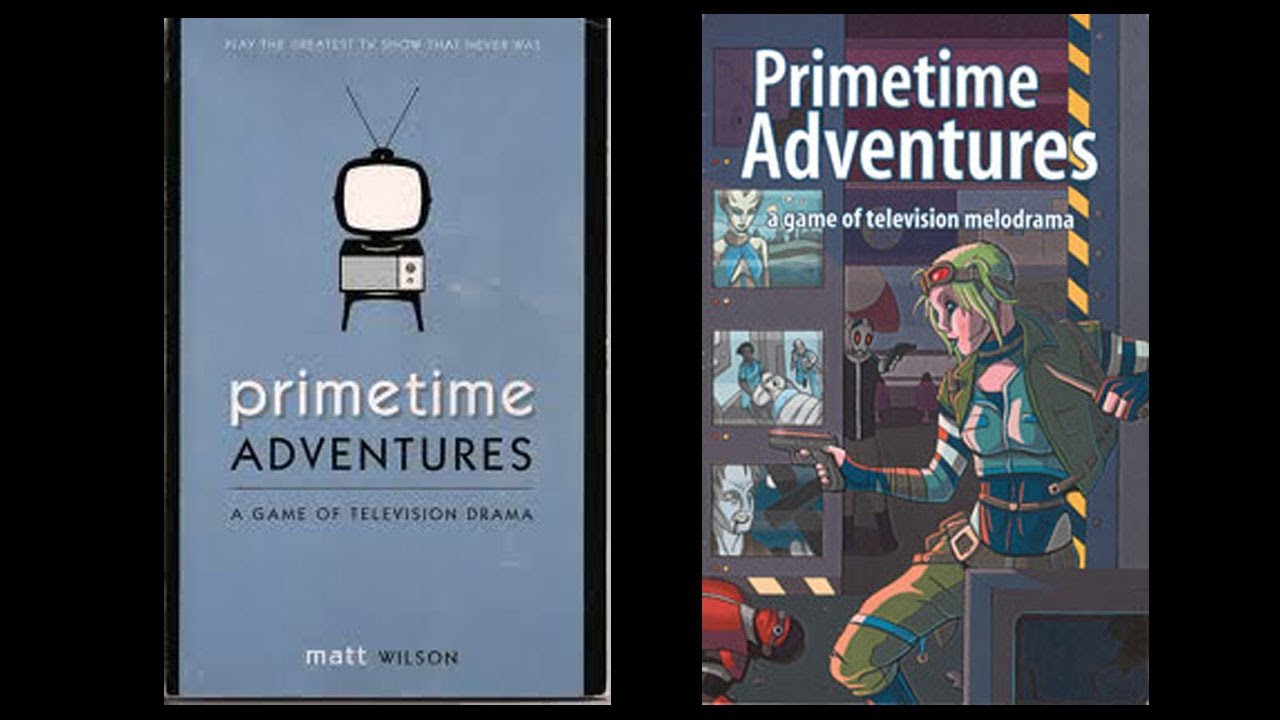
Image result for primetime adventures  Thinking on it, I one thing keeps popping up in my head.  It's a little book called Primetime Adventures. The version I own is the one on the left.  The idea behind Primetime Adventures is to tell a story- any story, in any genre- as if it were a TV series.  To this end, there's a very neat mechanic that I have not seen in any other game that I am rather fond of, and have adapted to other RPGs.  The idea is that you lay out your game sessions as a season of a show, with a number of episodes determined by the game master.  Then each character assigns numbers to each episode that reflect the prominence of their character to that episode.  This has two effects- one, the game master focuses on the characters when their high number episodes show up, and two, the character has more cards to play for task resolution in episodes with a higher number.  So, to use a Star Trek: TNG analogy, this is how you get the Data episodes and the Worf episodes- those would be the episodes where the players for Data and Worf had assigned their single maximum number for that season.  In all other episodes they would have lower numbers, and smaller hands of cards for task resolution.

  I found this to be a really neat way to make sure everyone has the spotlight at some point in a game campaign.  It might exist in other games, but the only place I've seen it is in Primetime Adventures.  So, there's my entry for Unique.