26 April 2020

The Wing Commander Connection


Wing Commander (video game) - Wikipedia

Sometimes the origin of some things are lost to history.  The reason for things obscured by time, and even though customs and traditions are handed down from generation to generation the reason for them is long forgotten.  This article is intended to explain and clarify some of the underpinnings of the gaming organization of which I am a founding member, and a member for a quarter of a century.

The formation of the Dragoons, then the Caladan Highland Dragoons, now the Royal Dragoon Guards, owes the unique nature of the organization in large part not to any tabletop game, and not to any martial background on the part of the founding members, but to a video game- ORIGIN's groundbreaking 1990 space flight simulator, Wing Commander.

Wing Commander was something new to me, and to most of the members of the gaming community at Round Rock High School back then.  It was a flight sim- but it had elements of a roleplaying game.  For those who have never played Wing Commander, the game came with a magazine, Claw Marks, that served as instructions, hints, and an introduction to the universe and characters of the game.  Inside Claw Marks were articles about the enemy, ship tactics, and the rank insignia and awards of the Terran Confederation.  It is this magazine and the mechanics of the Wing Commander campaign that laid the foundations for the Dragoons as we know them today.

A player of the Wing Commander game named their pilot, even though later games in the series bestowed the name Christopher Blair.  The pilot began the game as a second lieutenant.  If a player visited their locker, they would see their uniform with insignia and ribbons displayed.  Both of these would change as the game progressed- rank would be earned as the pilot's career progressed, and ribbons would be earned for various accomplishments.  A player could get an idea of how they were doing overall by these two metrics.

Some of these elements were also present in SSI's Renegade Legion: Interceptor game as well.

When the Dragoons first formed in a proto-version as a regular Battletech campaign with a handful of players in 1994, it resembled most gaming parties.  There was no actual organization to speak of, just players sitting down to play the MechWarrior RPG and the Battletech board game.  This even predates the use of the unit name "Dragoon" - the unit being played at that time was the 22nd Albion Hussars, a House Davion unit.  In an example of two hobbies cross-pollinating, things began to change when members of this game campaign began an attempt to become a chapter of STARFLEET, The International Star Trek Fan Association Inc. as the Shuttlecraft Retribution.  This effort ultimately petered out due to interpersonal issues- the Retribution never commissioned as a STARFLEET chapter.  But some of the structural elements of STARFLEET combined with the martial theme of the Battletech universe and the player award and rank system of Wing Commander when the Dragoons started to grow beyond what an unstructured game campaign could handle.

With first 10, then 15, and eventually 28 players, not counting GMs and OPFOR (Opposing Forces) players, the Dragoons grew so large some structure was needed to ensure smooth operations of the campaign.  The GM/OPFOR players discussed the issue as the group grew, and decided to take the Wing Commander approach to each player, pairing the approach to the organizational structure already in place in the Battletech game fiction.  The structure of the 'Mech Lance, four 'Mechs under a Lieutenant, combined into 'Mech Companies, three Lances commanded by a Captain, were perfect for streamlining a system by which the players themselves would help organize the gaming by being formed as Lances and Companies of an overall Dragoon Battalion.  Each member would create a single character, a Persona, whose career would be quantified by rank and awards for their in-game accomplishments, a-la Wing Commander.  The Wing Commander awards for Ace, Ace of Aces, and ejecting and surviving were ported over as-is.  Other awards were created as recognition for the accomplishments of the players and their characters. Leadership and assistance with running the organization were recognized with ribbons, as were in-persona awards for valor on the battlefield.

The Dragoons had taken on many of the elements that are cornerstones of the modern organization partially out of necessity- wrangling dozens of players and keeping them organized would be untenable for any group of GMs.  Having one out of every four players responsible for the other three helped with that task, and also established friendly rivalry between the lances and companies.  Awards and promotions became badges of recognition for accomploshments- both as a player and as a persona, and a mark of the responsibility in the organization.  With ribbons and ranks came the first Dragoon cosplay - old Vietnam-era US Army  khaki shirts with rank on the collar and ribbons over the pocket.  With so many players, the Dragoons began using actual formations for game briefings- how else can over two dozen teenaged and early 20s gamers be kept quiet and attentive long enough to give them their assignments for a massive Battletch game that regularly lasted all weekend?

Once those elements of the organization were established, many of the others followed.  Award ceremonies, saluting, Dragoon meals designed for serving mass quantities of food to many gamers as cheaply as possible... all hallmarks of the Dragoons over the years.

And it all began with applying Wing Commander's persona system to a group of ragtag Battletech players in order to rein in and organize a gaggle of young tabletop players.

05 March 2020

More Than Meets The Eye- Valor Knights

Thanks to Kickstarter's ZineQuest event, Bloat Games has graced us with Valor Knights: The Electrocube War, a 34-page 'zine style RPG with a definite 80s transforming robots vibe.  I scored Valor Knights in the Kickstarter, though I'm not sure it's available yet on DriveThru or other venues.  At 34 pages it was a quick read- but one that makes me want to bring it to a game table soon.  Very soon.

Within the Valor Knights RPG is a simple OSR-based system derived from The Black Hack and Bloat Games' own BoD system, using primarily the d20 and d6, but utilizing the standard dice for damage rolls etc.  Valor Knights is a class-level game with four classes (Leader, Warrior, Support and Mini-Bot) and levels that run from 1-10.

The titular Valor Knights are robotic beings from the planet Techtrillion, who are engaged in a war with the evil Chaos Lords over Electrocubes, their energy source.  Their war has found its way to Earth, and that's where the story of the Player Characters begin.

The game itself is perfectly rules light, allowing the Game Master to tweak and bend it as is befitting an Old School Renaissance game, as is explained on page 7 of the rulebook.  Rulings vs. Rules, a design ethos I've become more and more enthused by as I run one-shots and learning games for folks who have not played RPGs before.  The basic mechanic of this game is the d20 roll- with a twist.  Several years back, Fantasy Flight Games released their Star Wars RPGs and introduces a two-axis task resolution mechanic.  Tasks could succeed or fail, and have something fortunate or unfortunate occur.  These two axes were independent of one another.  This means you could succeed, but something bad happens.  Or fail, but something good happens.  Or any other combination.  In FFG's game, this required custom dice with custom symbols.  In Valor Knights, this is achieved with a standard d20 (success/failure) and a standard d6 (fortune/misfortune) for resolution of rolls.  The game also incorporates the popular Advantage/Disadvantage mechanic from Dungeons & Dragons 5th Edition.

The Attributes are the familiar six: Strength, Intelligence, Wisdom, Constitution, Dexterity and Charisma.  The game eliminates the traditional ability score in favor of generating and using the modifier itself- so no 18 Strength which gives a +3 modifier, the Strength would simply be +3.  This is fast and easy, and a table on page 11 gives the information to toss 6d6 and end up with a Valor Knights character.  The game adds a Luck stat, which allows re-rolls, and does slowly regenerate during the course of a campaign.

Armor Class gives way to Evade, which determines how hard the Valor Knight is to hit.  Armor Points act as damage resistance, though no successful attack can do less than 1 HP of damage.  Hit Points are determined by 10+Con score, modified by Class.  Interestingly, CON seems to only apply once, not at each additional level as in many OSR games.  Characters deal damage based on their Class and STR or DEX score, regardless in most cases to what type of weapon they wield.  In other words- weapon choice is purely stylistic, which is pretty cool in a world like Transf- erm- Valor Knights.  One could even go the GoBots route and allow the ranged attacks to be blasters generated from the fists of the character.  It's wide-open, anything goes.

The combat rules are short and sweet, and mostly in line with other games based on the original 1974 engine in some way.  One important difference jumped out at me- characters may choose two actions, but may do the same action twice.  So it is possible to double attack, which combined with one of the Warrior class abilities could be pretty impressive.  Your character could have The Touch.  The Powerrrrrrr.

Each class has special abilities to differentiate them from the other Valor Knights.  Leaders, of which there may be only one in any party, are what they say on the tin.  They lead, and their abilities are geared toward that end.  The Warrior class is also straightforward and geared toward its title.  Both of these classes are able to generate Ion Shields and Plasma Melee Weapons- the Ion Shield is universal to all Valor Knights, but the melee weapon is not.  The Support class are the scientists/technicians/Clerics/Ratchet/Wheeljack characters.  They are able to heal and generate force fields.  The Mini-bot class are pretty cool- small, fast, lucky and perfect for playing a Bumblebee or Cliffjumper.

Bad Guys(tm) do damage to Valor Knights based on their HD- so once again, it's up to the Game Master to provide the "skin" for the weapons.  They can be anything, take any form, but they will do appropriate damage to the threat represented by the Bad Guy in question.  The long way 'round is to stat up the Chaos Lords as PCs, and use those stats as well.

The book concludes with some sample characters, all of which feel like good fits for the genre.  All told, this little book contains the seeds of what could be a pretty awesome one-shot or campaign game.

So... that got me thinking.

Geeks of a Certain Age remember when Transformers came with TechSpecs cards that told you all about their abilities.  What if you could quickly and easily convert your favorite G1 Transformers into Valor Knights stats for a fast and furious Transformers RPG?

Start with this table:

10    +3
8-9    +2
6-7    +1
4-5    +0
2-3    -1
1    -2

Then apply the TechSpecs in the following manner:

Strength     = Strength
Intelligence     = Intelligence
Speed         = Dexterity
Endurance    = Constitution
Rank        = Level
Courage        = Charisma
Firepower    = *SPECIAL
Skill        = Wisdom

For Firepower, one could skip the damage supplied by Class and instead use the NPC damage table on page 28.  Bumblebee, with a Firepower of 1, would deal out 1d4 damage under this rule, with Megatron and his Firepower of 10 dealing 1d10+1d12 damage.  If this rule is used, HTH damage could be calculated the same way, but using the TechSpec Strength.

Since this is an OSR game with Rulings, Not Rules, a GM can delve into their own imagination or other OSR games to give abilities to the characters like Thundercracker's teleport, or Mirage's invisibility, or Hound's illusions.  Cliffjumper's glass gas might function as Hold Person.  Windchager's magnetic abilities might inflict 2d8 damage to metal items (from the table on page 28) and allow him to throw, move, or levitate things.  It's the OSR, go for it.

So, if you're a fan of 80s transforming robots and Old School RPGs, as soon as you can lay your hands on a copy of Valor Knights, it's just the ticket for a rules-light evening of transform-and-roll-out goodness.

01 March 2020

Savage Cyclone - Or, I Don't Wanna Wait

Taking a moment to post something non-D&D before jumping back into D&D And Me.

Savage Worlds Adventure Edition (SWADE) is here, as is Savage Robotech (Macross) and I couldn't be happier.  Thing is, while I love Macross, one of my favorite RPG settings is the Sentinels or Invid Invasion period of Robotech, largely for the inclusion of the Cyclone.  For the uninitiated in Robotech lore, the Cyclone is a single-pilot powered armor suit that can be reconfigured into a motorcycle (or is that the other way around) to provide mobility, protection and a weapon platform.  According to the lore, the Cyclone was also used as a survival package for downed pilots, as one is carried in a storage mode behind the cockpit of a Veritech Alpha Fighter.  We see LCDR Scott Bernard make use of the Cyclone in just this capacity in the first episode of the New Generation/Invid Invasion series.  If you've never seen a Cyclone in action, here's our first look at it from the TV series.

Image result for robotech cycloneAs a Game Master, the Cyclone was the perfect toy for my players.  It had the Rule of Cool, who doesn't want a badass motorcycle that transforms into a powered armor suit?  But it had a few things that were a gift to a Game Master.  First, the fuel supply was finite, but not too finite.  A single Protoculture Cell would last about a month, according to the RPG.  This verges on the "cinematic ammo" rule where it only matters when it's dramatic for it to matter.  When the GM feels it's time to be short on Protoculture, it comes into the plot.  Next, the Cyclone had various weapon systems available that were pretty effective- but not too effective.  The Alpha Fighter had SIXTY missiles, plus a gun pod.  The VR-052 standard configuration had four missiles, and the ability to use a handheld weapon.  The VR-041 had twelve missiles that seemed to be fired in volleys and about as individually effective as launched grenades, plus the vibro-sabers that were there, but never actually used in the cartoon.  The VR-038 had no internal weapons, but a hardpoint for an RL-6 rocket launcher used to effect by Rook Bartley.  So, you get heavy weapons, but not the overwhelming amount of them that come with full-sized Veritech mecha.  Last, but not least, the Cyclone was tough- but again- not TOO tough.  Well, if you were using Palladium rules, this last bit was kind of a lie.  You had 200MDC for the Cyclone (in first edition) and another 50 for your CVR-3 body armor.  This put you in the range of quite a bit of the full-sized mecha, and was far too butch against the Invid weapons that should have put fear into PCs the way it did to Scott, Lancer, Rook and Rand in the show.  So, gotta fix that.

Which brings me to the point of this post.  Right now, there is only the Robotech Macross book available for SWADE, so Cyclones have no official stats.  I'm going to create my own stats by taking a look at SWADE, SW Robotech, Savage RIFTS, and the great "Savaging Your Favorite RIFTS Ideas" PDF from Sean Patrick Fannon and Clint Black.  Now, a wonderful piece of advice Big Irish and Clint Black give in this document is to go for the feel of the gear, not a precise number-crunch from one system to another.  This was how Palladium System RIFTS became Savage RIFTS, and seems like a pretty good guiding star.

So, first things first.  The Cyclone requires a suit of body armor, the CVR-3 Armor, to work properly.  The Cycle part of the system uses the rigid CVR-3 Armor to lock on and create the powered armor configuration, without the armor, the conversion to powered armor mode would be impossible.  This gives me two tasks - One, create the CVR-3 Armor.  Two- Create the earlier CVR armor from the Expeditionary Force Marines sourcebook, since I intend to use both the production model cyclones and the prototypes and early -10 series models from that sourcebook.

So, let's see what we can find out about armor in SWADE, SW Robotech, and Savage RIFTS.

  • SWADE has "Futuristic Infantry Battle Armor" with an Armor of +6, D6 Minimum Strength, and the armor resists bullet damage by 4.
  • SWADE defines modern Kevlar-style armor with trauma plates as being +4 Armor (with 4 points of bullet resistance) and a Minimum Strength of d8.
  • Robotech Macross defines the predecessor to CVR armor, the CHR HARD suit, as +10 Armor, and a Min Str of d8.  A Tactical Vest and Tactical Armor both appear on this chart at a value of +4, which jives with the Kevlar armor above.  The text notes that these early suits were extremely bulky and hard to move in.
  • Savage RIFTS has a lot of armor.  AND an extra wildcard- the technology in RIFTS allows for armor to add to base Toughness in a way that cannot be negated by the Armor Piercing ability.  So let's look at a couple of offerings to compare to the others:
    • Old surplus pre-RIFTS armor has an Armor of +5, +1 Toughness, and a D6 Min Str.  This falls into line with the SWADE Futuristic Armor total mod of +6, albeit with one of those points being Toughness.
    • Bushman medium armor has a +6, with +2 to Toughness.  This brings it close to the +10 total of the Macross CHR HARD Armor, with a lower Min Str.
    • Triax Heavy body armor has a +7 Armor and +3 Toughness, making it  the equal of the Macross HARD, with the same Min Str and no harsh activity rules like the HARD Armor.
Given all these data points, what do we want the CVR-3 Armor to be able to do?  I'd like to think that in the mad rush of technology between the First Robotech War and the Pioneer Mission, the old HARD Armor would have given way to the more technologically advanced armors that we see in RIFTS, that is, be able to provide modest Toughness bonuses, though perhaps not as much as RIFTS armors and certainly not up to the level of the Triax armor.  The Savaging doc also recommends restraint in this department.  So that makes me want to look at CVR-3 as a Medium armor.  Partially because that's how it looks on screen, and partially because it leaves room for a slightly less effective version to stand in for the older CVR models, and a slightly beefier version if I decide later to put the VR-055 into my games- which I'm not at all sure I want to do, but I like my options open.  It is fair to note that the original guidelines in the Savaging document are broken by a couple of the armors in the revised for SWADE RIFTS player's book.  The Savaging Doc says RIFTS has a hard limit of +8 Armor and +2 Toughness, while the revised Tomorrow Legion gear sections has the Triax Medium and Heavy armors among others sneak in a +3 Toughness.

It appears the -4 AP versus bullets in the SWADE core book and Robotech are absent in RIFTS.  This leaves me with something of a conundrum- Robotech doesn't (yet) allow embedded Toughness, and RIFTS ditches the -4 AP of the SWADE core rules.  So... Here's how I'll resolve that in my games for now.  The -4 AP stands for any modern armor designed by a culture that has extensive recent reason to create ballistic-proof armors.  Like, say, humans.  We love guns.  We were still issuing projectile firearms as late as the Pioneer Mission and the Second Robotech War.  So, that attribute will still be there, albeit not used much, I'd wager, since most enemy weapons and standard issue Exepeditionary Force weapons will tend to be energy based after a certain point.  Toughness will be a thing for my games, since RIFTS is where most of my benchmark stats are coming from.

So, given those parameters and example armors, and extrapolating from the Macross setting's armors, let's see how this fits:

Early CVR Body Armor: Armor +5, Toughness +1, Min Str d6.  Bullets -4 AP
Standard CVR-3 Body Armor: Armor +6, Toughness +2, Min Str 6, Bullets -4 AP
Heavy CVR for VR-055: Armor +7, Toughness +2, Min Str d8, Bullets -4AP

So the Expeditionary Force leaves Earth with a suit of armor issued only to special troops and troops testing the new Walker Battloid and eventually the -10 series Cyclones.  It is superior to the Tactical armor of the First Robotech War, and easier to move in than the CHR HARD armor, but less protective overall.  Such is the price of mobility, but the resiliency of the armor is improving.  Later, the standard issue CVR-3 suit improves a bit on this armor, being just as easy to move in but harder to pierce, and represents the best the Expeditionary Force will get before returning to Earth as a mixture of agility and protective qualities.  The reinforced CVR developed for the VR-055 Devastator project offers more bulk and less freedom to movement, though not to the level of the old HARD suit, but offers protection in the form of Toughness embedded that the old HARD suit can't match.  A slightly lower protectiveness overall, but perhaps less brittle ceramic plating or something that explains the Toughness as opposed to standard armor.

Now we have the suit.  What about the bike?  Let's take a look at our sources.
  • SWADE lists a Dirt Bike as Size 0 and a Street Bike as Size 1.  Handling is +1 in both cases.  Toughness is 8 (Street Bike) or 7 (Dirt Bike) with no armor to speak of.
  • Robotech lists the KX1300P Patrol Cycle as being Size: 1, Handling +2, and Toughness: 10(2)
  •  RIFTS has the Highway-Man coming in at Size 1, +2 Handling, and a Toughness of 16(8), with the Wastelander being Size 3, much too big for a Cyclone.
OK, so it looks like we're going to go with Size 1, most example motorcycles work out this way.  Let's keep the handling of the beefier Cyclones, the -041 and -055, at +1 to match the less agile bikes and let the -038 have the +2 of the Patrol Cycle.  This will be compensated for in less armor and no integral weapons.  Hang on, though... powered armor works differently than vehicle armor, so now we have to come up with a simple hack to explain how we're going to deal with that.

By simple, I mean make sure the (N) after the Toughness in vehicle mode of the Cyclone needs to match the +N armor for the suit when in powered armor mode.  IE- the bike uses its' own Toughness when targeted as a motorcycle, and that of the rider and CVR Armor when targeted as a powered armor suit.  Easy peasy, but as I'm working this out I wonder if it will lead to problems down the road.  Namely, making the Cyclone tougher than it needs to be - I'm remembering the cyclones that could eat multiple missiles and keep trucking in the old Palladium game.  Well, I guess we'll see what we can come up with.  Reverse engineering the numbers above, it looks like most motorcycles have a a Toughness without armor of around 7-8.  This seems OK to me, so we'll go with 8 for the early Cyclones and the -038 model, and give a 9 to the beefier -041 and -055 models.

Now- to MDC or not to MDC?  In RIFTS, the SWADE Heavy tag is renamed MDC to go with the traditions of the Palladium RIFTS roleplaying game.  MDC stands for MegaDamage Capacity, and equates to the Heavy quality in Savage Worlds that means something is simply too tough for a regular sword, bullet or fist to damage.  A tank, for instance.  No matter how many dice Ace in a damage roll, a weapon without the Heavy/MDC quality simply can't hurt an object with the Heavy/MDC quality.  Savage RIFTS tries to take some of the MDC proliferation out of the game so that handheld weapons and personal armor are rarely MDC.  In Savage RIFTS, Power Armor confers MDC,  while the Highway-Man and Wastelander mototrcycles do not.  Larger APCs do, but most smaller vehicles don't.  For the purposes of making the Cyclone make sense, it kinda needs MDC to fit in with other Powered Armors, though it makes for a really hardy motorcycle!

Both example Power Armors in Savage RIFTS that are Size 1 give +8 MDC Armor and a +4 Toughness.  This appears to stack with worn armor, except our human-scale CVR-3 is not MDC in and of itself.  That means when the Cyclone is hit by MDC armor, we only care about the +MDC and +Toughness conferred by the powered armor, the CVR-3 becomes irrelevant.  If fired at by a weapon that doesn't to MDC, the CVR is still irrelevant as the MDC Armor renders any non-MDC attack moot.  This means someone in Cyclone powered armor is relatively immune to handheld weapons, but that is sort of borne out in the anime, so we'll go with it.

In Powered Armor Mode:
Size 1, Armor +8 MDC (+7 for the VR-038 and early Cyclones), Toughness +4 (+3 per Armor), STR d12+1 (d12 for early Cyclones and -038), Pace = Pilot's Pace (The Unofficial Robotech Reference Guide gives the cyclone's Battloid speed as the pilot's running speed)
Rudimentary flight system (Handling +0, +1 for the -038, hover to 120 MPH)

In Motorcycle Mode:
Size 1, Handling +1 (+2 to the -038), Top Speed 140 MPH, Toughness 17(8) or 15(7)

So, now we've got the bikes.  Let's look at the weapons.

The base VR-038 model has not built-in weapons, but it does have the RL-6 hardpoint.  The RL-6 fires rocket propelled grenades, with a six missile payload.  Taking a gander at example weapons to help us figure out what kind of damage the 76mm Tarantula rocket does, we find the following:
  • SWADE Bazooka: 4d8 damage, AP 8
  • RIFTS AP Grenade: 3d8, AP 16.  HE Grenade: 3d10, AP 4.  Plasma Grenade: 3d12, no AP.
  • RIFTS AP Mini-Missile: 4d6, AP 20.  HE Mini-Missile: 5d6, AP 8.  Plasma Mini-Missile: 7d6, AP 0.
  • Robotech Hydra 70 Rocket: 3d8+1, AP 8
All of these weapons are Heavy/MDC, so, big badda-boom.  We want effective, but not too effective.  The Hydra-70 is a modern 2.75" rocket used in great gobs from point-and-shoot launchers.  Unguided, air-to-ground, but a payload much like what we would expect from the 76mm Tarantula (the diameter comes from the Unofficial Robotech Reference Guide) but with less propellant.  IE, a launched grenade, not a true missile.  The anime shows that the Tarantula is at least semi-guided, as the RL-6 and the Cyclone both have targeting systems built-in, and we see dramatic views of the targeting reticle on the Cyclone shoulder coming up, gleaming in the sun, and then putting a round on target- usually an Invid sensor eye.

This data does give me a bit of pause, however- in the Palladium Robotech RPG, as well as the anime, it seems clear the plasma missiles from the GR-97 launchers on Scott's VR-052 Cyclone are more accurate and do nominally more damage than the Recluse missiles in Lancer's GR-103 shoulder mounts.  Scott normally fires one well-placed missile at a time, and Lancer often fires his in groups.  In the Palladium game, the Plasma/Napalm missiles did more damage than other mini-missiles, but in the Savage RIFTS conversion we see that Plasma does more damage, but has no armor-piercing capabilities.  This is a bit of a conundrum for the game modeling the show until one realizes that we see Invid sensor eyes popped by some weapons that probably aren't MDC.  Meaning that the sensor eye on an Invid mecha is probably NOT armored to MDC/Heavy standards.  Considering it's basically a ball turret sensor package behind which the pilot is housed, it conceptually can't be made of the same hard carapace armor, it's like saying you've got some armored camera lenses.  So, probably stout standard character scale Toughness, but NOT Heavy/MDC.  Once we decide that, the Plasma missile is still on top, leaving our translation still compatible with all our Savage sources.  Sure, we'll have to handwave and say that area effect MDC weapons still go up against the full overall armor of Invid mecha, but that's the way it works in the show.  Either hit them with overwhelming dakka, or hit them delicately in the eye.  One time with a Cyclone's foot.

RL-6 RPG LauncherWhich gets me thinking about all the other missiles and rockets.  So I guess we can go ahead and make some determinations on all of them now.  We're looking at three distinct missile platforms: The RL-6 firing the 76x180mm Tarantula, the GR-103 firing the 60x160mm Recluse, and the arm-mounted GR-97 from the VR-052 firing the 45x260mm Scorpion missile.

The URRG description of the Tarantula makes it a small armor-piercing round, making up for the small warhead by driving the missile into the target for an attempt at penetration before detonation.  I'm going to call this identical to the RIFTS AP Grenade, which has great AP but lower damage than the Hydra 70 or the good old Bazooka. 

GR-103 RPG launchersThe Recluse is explicitly described as a guided rocket propelled grenade, and also has a warhead comparable to the Tarantula.  It is also described as AP and HE.  So let's make it the equivalent of the RIFTS AP Grenade, but with a +2 damage for the slightly heavier warhead.

The Scorpion is a faster, more accurate missile but with a smaller warhead, but also explicitly a plasma missile.  Let's go with the RIFTS Plasma Mini-Missile so that the 7d6 damage might help make up for the 0 AP, and make the missile as effective as it is in the show while maintaining compatibility with the other Savage games.

So now we have the following:
  • RL-6 Rocket Launcher - As RIFTS AP Grenade (TLPG, pg 99) with a six-round magazine. +1 to hit at Short and Medium Range, +2 when Cyclone targeting reticle is deployed.
  • GR-103 Launcher - As RIFTS AP Grenade (TLPG, pg 99) with +2 to damage.  Six grenades in each chest section for a total of twelve. May be fired by volley.  +1 to hit at Short and Medium Range when Cyclone targeting reticle is deployed.
  • GR-97 Launcher - As RIFTS Plasma Mini-Missile (TLPG, pg 106) +2 to hit at Short and Medium Range when Cyclone targeting reticle is deployed.  Four missiles total, fired individually.
The CADS-1 system on the VR-041 Saber/Blowsperior Cyclone is an easy one- we'll use the Vibro-Longsword on page 97 of the Tomorrow Legion Player's Guide from Savage RIFTS.

That leaves us with two more cyclone weapons to look at.  The big rifle-like weapon Scott sometimes carries, the EP-37 60mm Particle Beam Gun, and Rand's arm-mounted EP-40 Pulse Particle Beam Gun.  For these, we will use the stats for the Northern Gun NG-45LP and NG-P7 on page 100 of the Savage Worlds TLPG.  These weapons are pretty close to exactly what the Robotech weapons are- the EP-37 will use the P7 stats, and the EP-40 will use the NG-45LP stats.  Both will get a bonus from the Cyclone's targeting system, and both can benefit from the Double Tap edge, but are not normally capable of auto-fire.

  • EP-40 Pulse Particle Beam Gun: As NG-45LP Pistol (TLPG, pg 100) with a 45 round magazine.  +1 to hit at Short and Medium Range when Cyclone targeting reticle is deployed.
  • EP-37 Particle Beam Gun: As NG-P7 Rifle (TLPG, pg100) with a 15 round magazine.
OK, so... now we have armor, Cyclones and their most common weapons.  Is there anything else?  Well, I can think of one thing as I type this and have episodes of Robotech running.  Agility.  The Cyclone has an incredible amount of agility unmatched by any other mecha humans pilot in the anime.  In the Palladium game this was modeled by giving the Cyclone battloid the rare Auto-Dodge ability, which allowed a defense roll without sacrificing an action during a turn.  Since SWADE does not have defense rolls as such, let's look at the Dodge and Improved Dodge Edges on SWADE page 41.  These Edges negate penalties and give bonuses to Evasion of area attacks.  This sounds about perfect for the jumping, flipping, hovering, and rocketing we see the Cyclones doing in the anime.  Watch how Scott hops, skips and jumps in his battles in the first two episodes of The New Generation.

So we will run with this rule:

EDGE:
CYCLONE RIDER
Requirements: Novice, Drive d6+

The hero is  fully trained in the use of the Cyclone powered armor system.  When using a Cyclone in Battloid Mode, the hero is treated as having the Dodge Edge regardless of any other requirments for that Edge.  A hero with this Edge piloting a VR-038 Cyclone in Battloid Mode receives the additional benefit of the Improved Dodge Edge.

That's about all I have to say about Cyclones for one sitting.  It's 0130 as I write this and I've been slamming out my Savage Robotech thoughts for a while now.  I hope this is useful to someone out there in TV-land.


04 February 2020

D&D and Me Vol. 3: AD&D Second Edition


 This is AD&D 2nd Edition as I prefer to remember it.  This glorious Jeff Easley cover, the iconic logo in blue, white and red.  The older TSR logo in black at the bottom of the cover.  Inside were pages with blue accents and titles, interspersed with color plates including the absolutely iconic Elmore piece "Dragonslayers and PROUD OF IT."

I remember being blown away by this book.  My previous D&D books were, by and large, saddle-stitched cardstock-covered BECMI books.  I had a couple of AD&D hardcovers, the orange spine prints, but inside those books were matte pages in black and white throughout.  The production values of the 1989 2nd Edition PHB were like nothing I had ever seen.  The book itself was gorgeous beyond belief.  It was easy to read, well-organized, and written in a comprehensible language.  The combat rules were now something the player could reference, and the to-hit mechanic was now mathematical, no charts or table needed.  To my teenage mind, it was a quantum leap forward in both ease of play and presentation.

These D&D and Me articles are as much about who I was and what I was doing at the moment in time I encountered each edition of D&D as they are D&D itself, because like music and popular culture we each imprint on things in varied ways due to the circumstances of our lives at that moment in time.  In 1989, the first time I held this amazing tome, I was beginning my freshman year of high school and stepping into a new world in more ways than just a new version of AD&D.  This was the final phase of childhood- where we wanted so desperately to grow up, to be adults, not knowing these years would be the last ones in our lives we could look back upon as carefree.  AD&D 2nd Edition would pair with BECMI as our go-to game, the spine of our group's roleplaying efforts, while branching off like a snake's ribcage was an explosion of other games we'd play for more or less time as we voraciously devoured everything.  Cyberpunk, GURPS, 2300 AD, Space: 1889, Paranoia, Twilight: 2000, RECON, The Morrow Project, Vampire: The Masquerade, Nightlife, and so many others.  Not to mention Battletech, which I'd started in 1986 at the lunch table and had increasingly captured the sci-fi part of my brain.

In '89 I was a fan of Information Society and the B-52s.  I wore combat boots a lot, but more because of JROTC than because I was proto-goth.  I mean, I did wear a lot of black, but if anything I was a holdover from synthpop.  As the 80s became the 90s, I never really left the 80s.  I was a cosplayer before cosplay was a word, and got quite a bit of shit over it.  I had several Star Trek and TNG uniforms, and alternated their wear with my Marine Corps JROTC uniform.  Above all, I was a gamer.  My weekends were spent gaming, invariably.  Overnights were almost always for gaming purposes. 

We fell, in many ways, prey to that terrible malady that makes gamers think basic D&D is the kiddo version of the game.  Now, in my forties, I know that B/X or BECMI is a fine way to spend gaming time, and just as worthy as any other version of the game.  I love OSR products like Swords & Wizardry and Labyrinth Lord, but in '89 only a subset of my friends wanted to keep playing basic.  AD&D was where the big kids played.  And so I kept my BECMI campaign going with Bill, Chris and Dave and played AD&D with everyone else.

Second Edition brought many great things to the table- like making the Non-Weapon Proficiency system we saw in supplemental books a part of the PHB.  Now it was expected that characters would have "skills" outside their class abilities.  Magic was cleaned up and organized, and more than just Illusionists possible as specialty casters became a regular feature.  We lamented the loss of the Assassin, Monk and Half-Orc... and demons... but having been on the front lines of the Satanic Panic myself, defending the hobby at my church, I really couldn't argue with that decision at the time.  Initiative was not such a mess it would eventually generate a pages-long description of how it actually worked on the internet.  AD&D had come of age as far as being a polished product for presentation to the masses.

The Monstrous Compendium was a glorious idea that didn't *quite* work as intended.  The massive 3-ringed binder of monsters was an incredible resource of information.  No monster had the tiny entries the original Monster Manual mostly contained, each monster was distinct and colorful.  Ecology and background, full-color illustrations, all in a package that allowed MORE monsters to be added later, or the DM to re-organize the pages for monsters they used more often.  Much like my beloved copy of Battletech Technical Readout 3025, I pored over this volume for hours at a time just soaking up information and background.

The Dungeon Master's Guide was initally a letdown in that we could all see it was so much thinner a volume than the original.  Many things from the OG DMG were missing.  In hindsight, I realize that combat was moved largely to the PHB, and things like artifacts moved to their own book.  The advice was solid, and the article on how to create classes from scratch locked me into several afternoons of building custom classes for game worlds I created that never got played.  The improved organization of the DMG made up for the changed content, and the content that was there was first rate.

So, I loved the actual books.  Let's talk about support.  I was reading Dragon Magazine monthly at this point- Hasting's carried it, and I could walk there from home.  This period was my personal Golden Age of Dragon Magazine, and I often re-read those issues thanks to the Dragon Magazine Archive CDs.  But it wasn't just Dragon- there were splatbooks.  Holy crap were there splatbooks.  The leatherette sourcebooks flowed, with everything from class guides to equipment to castles to a series on historical periods.  Again, when I need to center, and find my happy place, it is often one of these books that finds its way into my hands.  I have a spare copy of the Arms & Equipment Guide in my bedroom bookshelf for just such emergencies.  These books were invariably fun to read, but had mixed utility.  Some of the Complete books were not balanced well against others, and resulted in differing levels of character abilities when mixed and matched.  Thing was, we were teenagers and didn't let that stop us.  The Cleric splat is often pointed to as the "weak" one, with most kits depowering the Cleric in one area or another.  But our group moved from monty haul to story building pretty quickly- so this wasn't that big an issue.

2nd Edition seemed to lend itself to the transition the industry seemed to be undergoing from hack-and-slash to storygaming.  I6 - Ravenloft and the Dragonlance series started to place story ahead of combat, and 2nd Edition seems to have embraced that in a big way.  Experience Points were now coming from (potentially) class-specific actions and goal achievement, not simply gold pieces looted.  Roleplay was encouraged from the get-go right down to the explanation of how to use the Ability Scores to ascertain a personality for the sample character, Rath.

We also got game settings.  LOTS of them.  Grayhawk and Forgotten Realms, of course.  But Ravenloft became a Domain of Dread, not just a castle in Barovia.  Birthright, Dark Sun, Spelljammer, Maztica, Al-Qadim, and even an attempt to bring The Known World into AD&D as Mystara.  So. Many. Worlds.  So many, in fact, that it created a product glut according to some game historians.  But the main idea was that this period in AD&D history was full of creation and imagination.  It brought TSR low, sadly, but what a glorious ride.

Whereas BECMI brought me into the hobby, and AD&D gave me an idea of what detail and crunch could be, AD&D 2nd Edition hit me at a particularly formative age.  I was figuring out who I was during this period as most of us do in High School.  It became part of my identity, to the point that my first tattoo was the ampersand used in the BECMI and 2e logos.  Much of the music I still listen to, TV shows I still return to, the world I dearly miss- all of this was peaking when AD&D 2e came out.  And just as, for me, popular culture declined after this point to something I no longer identify with, so, too did TSR and AD&D.  When 2E was reprinted in the "Black Border" editions in the mid-late 1990s, I was no longer grooving to what the world was, what popular music was, or popular culture.  To this day, while I collect roleplaying games of all kinds, I skip the black border editions at Half Price Books in favor of another copy of the earlier covers.  I was really pissed that the commemorative reprints were the later printings, with the changes in trade dress and artwork.  But that's me, I'm a grognard for the 80s, and time marches on.

Still, when I see the sea green banded character sheets from this edition, or a brown or green leatherette splat book, or one of the many adventures and supplements from this time period- especially Ravenloft- I get homesick for AD&D 2e.  A lot of my high school experience was this game, and these books, and these worlds.  That's D&D and Me for AD&D Second Edition.

27 January 2020

The High Cost of Magic in Shadowrun


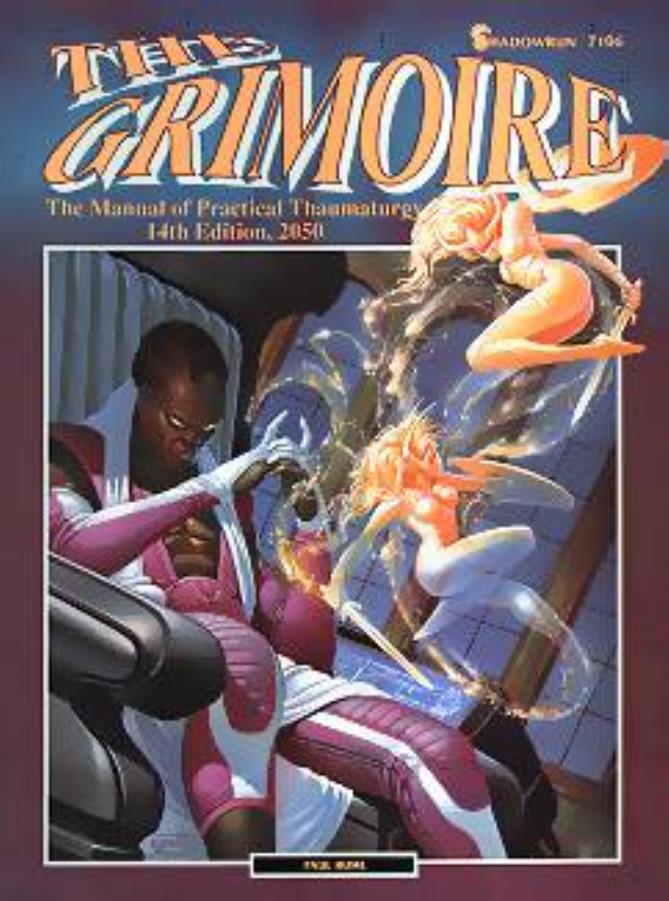
Image result for shadowrun grimoire"Magic.  One of the things that sets Shadowrun apart from other Cyberpunk settings in a jarring, significant way.  In First Edition, magic is frighteningly powerful- able to drop a charging Troll in a single, well-cast spell.  Things missing from later editions are equally terrifying- like the ability to petrify a living being into a lump of calcified tissue, or simply turn them to goo.
When you're not goo-ing someone or hitting them with mana bolts, you might summon a spirit or elemental to do your bidding.  Ply the Astral spying on a mark, or or throw your Magic Pool into spell defense to save your team's collective hoops.  There's a LOT of mojo that can be thrown around by a Mage or Shaman with a mind to do so.  But what is the cost of doing so?  What must a chummer trade in order to wield such immense power?
A lot, it turns out.  A whole fragging lot.
Using Grimoire with Shadowrun First Edition gives you the option to be a full-on Mage or Shaman, or an Adept.  Adepts are "aspected" magic users, only able to harness magic in specific ways.  We're going to talk about adepts later, for the purposes of this article we're discussing full mages.  There are several types of Adepts, thus covering them separately.  Casters able to command the full repertoire of magical hoodoo fall into two broad categories- Hermetic Mages and Shaman.

The Mage/Shaman dichotomy was one of the wonderful things about Shadowrun in the early days.  In most popular RPGs during this time, there were things like specialty mages (Illusionists etc.) here and there, but I don't recall anything as thematic as Mage/Shaman until years later.  One could argue that AD&D Druids are sort of in this vein, especially since they had their own rules for picking holly etc. or one might argue the old Divine/Arcane split between Clerics and Mages is the same thing, but bear with me, here, I'm working from how all of this hit my 15-year-old gamer sensibilities at the time.  I think maybe it was the heavy influence of Native American tropes that really weren't seen anywhere else, at least not in our game group's experience.

So, full casters of both flavors can do an awful lot, so much, in fact, that in my 30 years of playing Shadowrun I've only rarely run across players who actively use all of those abilities.  I've seen a lot of players and GMs ignore the Astral completely, for many of the same reasons they skip or handwave the Matrix rules.  It can be complicated, and it takes the caster to a realm the rest of the party cannot access, forcing a pizza break for everyone who isn't Awakened.  The basic abilities wielded by these characters are Sorcery, Conjuring and Astral stuff.

Sorcery is the ability to fling spells.  Spells can be cast on the fly, or as rituals.  There are many spells to choose from, from illusion and detection to manipulation to elemental to combat.  Unlike most RPGs, there are no spell slots or spell points, in Shadowrun if you're careful, and your dice love you, you can cast infinite numbers of spells- until you push too far, or your dice luck runs out.  This is the ability far and away most used by PC casters to do dirty deeds.  And it's ridiculously effective- here's why.

In Shadowrun First Edition, the Sorcery skill is important in two basic ways.  First, it determines the number of dice in the character's Magic Pool.  This is a pool of dice that can be used to agument the spell, help offset Drain, or be allocated to defend allies.  The higher the skill, the more of these dice you have to throw around.  Second, the Sorcery skill becomes the target number for the poor slots you're working your mojo on.  The higher the skill, the harder it is to resist the spell regardless of the Force of the spell the mage is casting.

Force, you see, is the umph behind the spell, and sets the number of dice the spell will roll against the target.  In SR2 and later, the Force becomes part of the ability of the target to resist the spell- but in Shadowrun First Edition... the more skilled the caster, the harder it is to resist the spell, regardless of Force.  So, in SR1, pumping up ones Sorcery skill both raises the target number folks need to "save vs." your spells, AND increases the Magic Pool you an use to stick it to 'em, regardless of spell Force.  Sure, there's some give and take here- but overall it makes life extremely difficult for your victims.

Conjuring is the ability to summon spirits to come to your aid.  Mages tend to conjure Elementals, and they tend to be done by ritual, and hang about until they have performed a specified number of tasks.  Shaman can summon nature spirits on the fly, but they also tend to take off at the next Sunrise or Sunset.  Elementals once summoned and bound hang around in the Astral until called, and generally can be called for one service per success on the summoning roll.  So, Shaman can call nature spirits on the spot, Elementals are a mage thing, and require an hours-long ritual. Mages and shaman can also banish or control spirits.

That brings us to Astral stuff.  Perception, the ability to see into the Astral plane and assense things, like auras, magical items, Ritual sorcery underway, etc.  It's a powerful ability that allows for a lot of intelligence gathering and forewarning.  Add to that the ability to Astrally Project- leaving the body and projecting a being of pure magical spirit into Astral space.  Magicians can travel Astrally at thousands of kilometers per hour.  Engage in Astral combat against other magicians, spells themselves, Awakened creatures... And in Astral space, a character's physical attributes, if they can be called that, are based on the magician's mental attributes.  So the weak, sickly wizard can become a powerhouse in Astral space.

So... phenomenal cosmic power.  Sling spells, conjure spirits, travel the realm of spirit and magic itself.  Your spells that injure through pure magic ignore 95% of the armor options out there.  Your spells that attack Willpower can drop trolls in their tracks (maximum Willpower 5) and your Magic Pool can help defend your team while they geek the enemy casters.  What, pray tell, is this cost we said was to be paid earlier?

Shadowrun uses a system of priorities to create characters.  There are five items players prioritize by assigning the numbers 0-4 using each number once.  Those items are Magic, Attributes, Skills, Tech and Race.  The higher the number assigned, the more of that resource is available to create a character.

To be a full magician, not one of those adepts we'll look at in another article, one must put Priority 4 into Magic.  Period.  And that's if the character being created is human.  Metahuman magicians must put 4 in Race, and 3 in Magic to qualify.  This requirement is pretty harsh, because your next choices become extremely difficult to make once these initial numbers have been placed.

Attributes are important to a caster- Willpower is key to resisting Drain, and Charisma is extremely important for conjuring.  Reaction, which determines initiative, is calculated from Intelligence and Quickness.  Cybered up Street Samurai are going to be trying to kill you, and they are going to move very, very fast.  Reaction needs to be as good as you can make it, or they'll geek you before you can toss your first manabolt.  Intelligence also determines Astral Pool dice.  Oh, and Intelligence, Willpower and Charisma are also used to determine how your Astral self performs.  Strength and Body?  Well, those aren't that important until you need Body to resist incoming damage.

Skills are vital- Sorcery, Conjuring and Magical Theory are all a must to be a working magician.  If you're using Grimoire, Enchanting is a thing.  Do you want to be able to wield a mageblade?  You're going to need Armed Combat.  Etiquette comes in useful, as does Negotiation.  Can you ride a bike, or drive a car?  Necessary skills add up very quickly, and you're going to want your magical ones to start as competently as possible.

Tech- we can skimp on that one, right?  No need for tech when you're a mage or Shaman.  Except there is.  Next to each entry in Tech is a slash, followed by a number.  This is the number of Force points your mage begins the game with.  Divide these up between all the spells you want to know, and that's your entry-level spellbook.  Plus, fetishes, spell focus items, and your Medicine Lodge or Hermetic library will be expensive.

So, let's look at creating a Human caster.  Priority 4 is gone right away, and we can toss 0 to Race to get it out of the way.  Now comes an interesting debate.  We can throw 3 into Attributes, giving us 24 points to spend.  This can result in, if you're min-maxing, a 6 in each mental attribute, and a 2 in each physical.  But that would lower Reaction, and mean only two dice to help resist incoming damage.  One could go for even 4s across the board.  That's not too bad.  But to put that 3 into Attributes means it's not going into Skills or Tech.  It would buy us 30 points of Skills.  This means the character could max out (6) Sorcery, Conjuring and Magical Theory and still have 12 points left over for other things.  Not a bad choice.  But a Tech of 3 gives the character 400,000 nuyen to spend AND a whopping 50 Force points.  That's 8 spells at Force 6 plus one more oddball at Force 2.  Quite a portfolio. But only one of these choices can be made.

The 2 must be next, and in Attributes that buys the magician 20 points.  Now things are getting dire.  Human average is 3 in Shadowrun, which means the Attributes could go 3 across the board, with enough points left to bump one up to 5, or two up to 4.  Not terrible, but also not a standout, and as noted above, casters need serious mental mojo to make the best of everything a caster can do in Shadowrun.  So maybe we want to put the 3 in Attributes, and give the 2 to Tech or Skills.  24 points in Skills is pretty decent- you can still max out the three Magic skills and have 6 points left over for incidentals.  But that doesn't leave the character with a lot they can do *but* magic stuff.  Tech would score the mage 20,000 nuyen and 20 Force points.  So, take a look at that drop again.  From 400,000 nuyen to 20,000, and from 50 Force points to 20.  Now things are starting to look a bit harder for the player.  Less than half the spells of the previous level.  Ouch.  And 1/20 the cash to spend.  Maybe we can make it on 20 Force points to begin with, and 20,000 is enough for starting magical equipment and a few months (very) modest living paid up front.  Forget that mageblade, though.

Priority 1 offers 17 Attribute points- ugh.  At this level your new magician has less than average Attributes overall.  And trying to put significant points into any one will slight the other five something terrible.  Skills?  20 points, not as bad, but at this point the Magic skills might have to take a hit to provide a few precious points for other skills.  Tech?  1,000 nuyen and 10 Force points.  Barely enough for some modest starting gear, and a pair of Force 5 spells.

Good thing we don't have to look at Priority 0.  Except we do - what if we wanted to make a Metahuman caster?  That means 4 and 3 are taken, and 0 can't be tossed away on Race.  It also means all those juicy rewards for Priority 3 are locked up in making our character magically active, so we start with the rather less impressive choices of 2 and go down from there.

Priority 0.  Attributes- 15 points.  Three 3s and three 2s?  Or mix some 1s in there and pray for the dice to roll well?  This character is now significantly below average.  Elves get an extra 3 points in the form of +1 to Quicknes and +2 to Charisma, Dwarves get +1 Body, +2 Strength, +1 Willpower and -1 Quickness for a net gain of 3 points.  Orks... well, they get +3 Body, +2 Strength, -1 Charisma and -1 Intelligence which is going to hurt them as casters, and is a net bonus of +3. Trolls.  Trolls get +5 Body, -1 Quickness, +4 Strength, -2 Charisma, -2 Intelligence, -1 Willpower.  Net bonus is +3, but OUCH.  Just to get a 1 in all the Mental attributes a Troll would have to spend 8 points.  More than half of the 15 possible at this level.

Skills at Priority 0 are 17 points, not enough to be great at all three Magical skills.  So maybe short Magical Theory and survive long enough to learn it, you won't be creating any spells this soon anyway, right, chummer?  Tech is 100 nuyen, and 5 Force points.  Ummm... yeah.  That's one good spell, or a couple crappy ones.  And forget buying any significant gear.

So, magically active characters have to give up their top one or two priorities in order to be magically active.  Meanwhile, other types of characters can score a cool million nuyen for cyberware and gear and vehicles.  Or maybe 30 Attribute points, enough to go straight 5s, or 6s in all mental Attributes and 4s in all Physical.  Damn, that would be great for a Mage or shaman.  Or maybe they have 40 points of Skill.

But the cost doesn't end there.

Magical characters can have ZERO cyberware without losing some of their precious magic.  None.  ANY cyber reduces their Essence, even 0.01 points, and Magic falls a full point.  Now, the bright side is you can now pack on cyber until you hit a full point of Essence without further immediate loss, but go a tad over that an BOOM.  Another point of Magic gone.

No problem, I can cast as long as I have one point of Magic left, right?  Well, there's the rub.  Cast a spell with a Force higher than your Magic attribute (which starts at 6 if you have one at all) and the Drain isn't just a tired, fatigued feeling.  The Drain is physical damage.  Blood vessels burst, heart flutters, muscle spasms... death.

OK, so, I skip on Cyber.  I'm OK, right?

Maybe.

Another cost of being a mage or shaman is that medics have a very hard time treating you due to your magical nature.  They have a penalty to heal you, because they can't make use of their most technologically advanced curative measures.  If they do, you see, they can cause you to lose points of Magic.  They can choose to ignore the penalty, but then it's time to check for Magic loss.  So you're on your way to burnout and it's not even your fault.

OK, I can deal with all of that.  I still want to be a mage or shaman. Sign me up.

The cost just keeps going, omae.  You see, if you want to become more powerful, you have to take all that delicious Karma your friends are using to boost their Attributes, learn new skills, and spend on saving their butts, and you have to sink it into magic crap.  Lots and lots of magic crap.

Bonding magical items, for one.  Want to increase the maximum Force of a spell you know?  Great.  You learn it all over again, at full Karma cost.  It doesn't matter that you already knew a lesser Force version.  You're paying full cost for the new one.

Oh, you want to become an Initiate, like in Grimoire, and be part of a Magical society and raise your Magic attribute and learn how to use shiny new Magical skills?  Pay up for Initiation, chummer.  And it ain't cheap.  All those wonderful Karma points you could be spending all over the place... all going to Magic.

Magic has a very, very high cost in Shadowrun, both to become a full spellcaster to begin with, and to maintain your edge and improve your magical repertoire.  Is it worth it?  That's up to you.  See you in the Shadows.