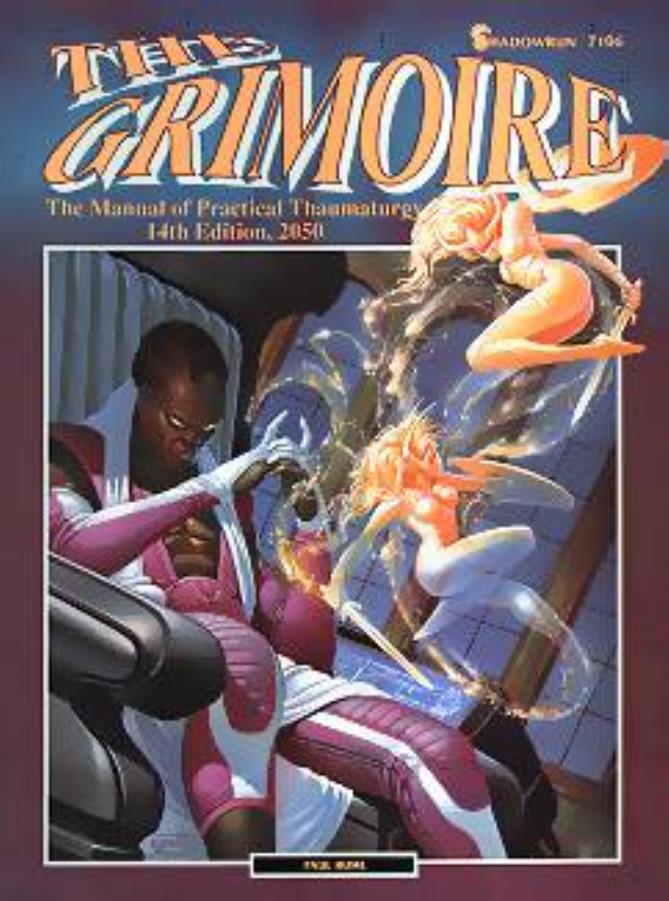
 Magic. One of the things that sets Shadowrun apart from other Cyberpunk settings in a jarring, significant way. In First Edition, magic is frighteningly powerful- able to drop a charging Troll in a single, well-cast spell. Things missing from later editions are equally terrifying- like the ability to petrify a living being into a lump of calcified tissue, or simply turn them to goo.
When you're not goo-ing someone or hitting them with mana bolts, you might summon a spirit or elemental to do your bidding. Ply the Astral spying on a mark, or or throw your Magic Pool into spell defense to save your team's collective hoops. There's a LOT of mojo that can be thrown around by a Mage or Shaman with a mind to do so. But what is the cost of doing so? What must a chummer trade in order to wield such immense power?
A lot, it turns out. A whole fragging lot.
Using Grimoire with Shadowrun First Edition gives you the option to be a full-on Mage or Shaman, or an Adept. Adepts are "aspected" magic users, only able to harness magic in specific ways. We're going to talk about adepts later, for the purposes of this article we're discussing full mages. There are several types of Adepts, thus covering them separately. Casters able to command the full repertoire of magical hoodoo fall into two broad categories- Hermetic Mages and Shaman.
The Mage/Shaman dichotomy was one of the wonderful things about Shadowrun in the early days. In most popular RPGs during this time, there were things like specialty mages (Illusionists etc.) here and there, but I don't recall anything as thematic as Mage/Shaman until years later. One could argue that AD&D Druids are sort of in this vein, especially since they had their own rules for picking holly etc. or one might argue the old Divine/Arcane split between Clerics and Mages is the same thing, but bear with me, here, I'm working from how all of this hit my 15-year-old gamer sensibilities at the time. I think maybe it was the heavy influence of Native American tropes that really weren't seen anywhere else, at least not in our game group's experience.
So, full casters of both flavors can do an awful lot, so much, in fact, that in my 30 years of playing Shadowrun I've only rarely run across players who actively use all of those abilities. I've seen a lot of players and GMs ignore the Astral completely, for many of the same reasons they skip or handwave the Matrix rules. It can be complicated, and it takes the caster to a realm the rest of the party cannot access, forcing a pizza break for everyone who isn't Awakened. The basic abilities wielded by these characters are Sorcery, Conjuring and Astral stuff.
Sorcery is the ability to fling spells. Spells can be cast on the fly, or as rituals. There are many spells to choose from, from illusion and detection to manipulation to elemental to combat. Unlike most RPGs, there are no spell slots or spell points, in Shadowrun if you're careful, and your dice love you, you can cast infinite numbers of spells- until you push too far, or your dice luck runs out. This is the ability far and away most used by PC casters to do dirty deeds. And it's ridiculously effective- here's why.
In Shadowrun First Edition, the Sorcery skill is important in two basic ways. First, it determines the number of dice in the character's Magic Pool. This is a pool of dice that can be used to agument the spell, help offset Drain, or be allocated to defend allies. The higher the skill, the more of these dice you have to throw around. Second, the Sorcery skill becomes the target number for the poor slots you're working your mojo on. The higher the skill, the harder it is to resist the spell regardless of the Force of the spell the mage is casting.
Force, you see, is the umph behind the spell, and sets the number of dice the spell will roll against the target. In SR2 and later, the Force becomes part of the ability of the target to resist the spell- but in Shadowrun First Edition... the more skilled the caster, the harder it is to resist the spell, regardless of Force. So, in SR1, pumping up ones Sorcery skill both raises the target number folks need to "save vs." your spells, AND increases the Magic Pool you an use to stick it to 'em, regardless of spell Force. Sure, there's some give and take here- but overall it makes life extremely difficult for your victims.
Conjuring is the ability to summon spirits to come to your aid. Mages tend to conjure Elementals, and they tend to be done by ritual, and hang about until they have performed a specified number of tasks. Shaman can summon nature spirits on the fly, but they also tend to take off at the next Sunrise or Sunset. Elementals once summoned and bound hang around in the Astral until called, and generally can be called for one service per success on the summoning roll. So, Shaman can call nature spirits on the spot, Elementals are a mage thing, and require an hours-long ritual. Mages and shaman can also banish or control spirits.
That brings us to Astral stuff. Perception, the ability to see into the Astral plane and assense things, like auras, magical items, Ritual sorcery underway, etc. It's a powerful ability that allows for a lot of intelligence gathering and forewarning. Add to that the ability to Astrally Project- leaving the body and projecting a being of pure magical spirit into Astral space. Magicians can travel Astrally at thousands of kilometers per hour. Engage in Astral combat against other magicians, spells themselves, Awakened creatures... And in Astral space, a character's physical attributes, if they can be called that, are based on the magician's mental attributes. So the weak, sickly wizard can become a powerhouse in Astral space.
So... phenomenal cosmic power. Sling spells, conjure spirits, travel the realm of spirit and magic itself. Your spells that injure through pure magic ignore 95% of the armor options out there. Your spells that attack Willpower can drop trolls in their tracks (maximum Willpower 5) and your Magic Pool can help defend your team while they geek the enemy casters. What, pray tell, is this cost we said was to be paid earlier?
Shadowrun uses a system of priorities to create characters. There are five items players prioritize by assigning the numbers 0-4 using each number once. Those items are Magic, Attributes, Skills, Tech and Race. The higher the number assigned, the more of that resource is available to create a character.
To be a full magician, not one of those adepts we'll look at in another article, one must put Priority 4 into Magic. Period. And that's if the character being created is human. Metahuman magicians must put 4 in Race, and 3 in Magic to qualify. This requirement is pretty harsh, because your next choices become extremely difficult to make once these initial numbers have been placed.
Attributes are important to a caster- Willpower is key to resisting Drain, and Charisma is extremely important for conjuring. Reaction, which determines initiative, is calculated from Intelligence and Quickness. Cybered up Street Samurai are going to be trying to kill you, and they are going to move very, very fast. Reaction needs to be as good as you can make it, or they'll geek you before you can toss your first manabolt. Intelligence also determines Astral Pool dice. Oh, and Intelligence, Willpower and Charisma are also used to determine how your Astral self performs. Strength and Body? Well, those aren't that important until you need Body to resist incoming damage.
Skills are vital- Sorcery, Conjuring and Magical Theory are all a must to be a working magician. If you're using Grimoire, Enchanting is a thing. Do you want to be able to wield a mageblade? You're going to need Armed Combat. Etiquette comes in useful, as does Negotiation. Can you ride a bike, or drive a car? Necessary skills add up very quickly, and you're going to want your magical ones to start as competently as possible.
Tech- we can skimp on that one, right? No need for tech when you're a mage or Shaman. Except there is. Next to each entry in Tech is a slash, followed by a number. This is the number of Force points your mage begins the game with. Divide these up between all the spells you want to know, and that's your entry-level spellbook. Plus, fetishes, spell focus items, and your Medicine Lodge or Hermetic library will be expensive.
So, let's look at creating a Human caster. Priority 4 is gone right away, and we can toss 0 to Race to get it out of the way. Now comes an interesting debate. We can throw 3 into Attributes, giving us 24 points to spend. This can result in, if you're min-maxing, a 6 in each mental attribute, and a 2 in each physical. But that would lower Reaction, and mean only two dice to help resist incoming damage. One could go for even 4s across the board. That's not too bad. But to put that 3 into Attributes means it's not going into Skills or Tech. It would buy us 30 points of Skills. This means the character could max out (6) Sorcery, Conjuring and Magical Theory and still have 12 points left over for other things. Not a bad choice. But a Tech of 3 gives the character 400,000 nuyen to spend AND a whopping 50 Force points. That's 8 spells at Force 6 plus one more oddball at Force 2. Quite a portfolio. But only one of these choices can be made.
The 2 must be next, and in Attributes that buys the magician 20 points. Now things are getting dire. Human average is 3 in Shadowrun, which means the Attributes could go 3 across the board, with enough points left to bump one up to 5, or two up to 4. Not terrible, but also not a standout, and as noted above, casters need serious mental mojo to make the best of everything a caster can do in Shadowrun. So maybe we want to put the 3 in Attributes, and give the 2 to Tech or Skills. 24 points in Skills is pretty decent- you can still max out the three Magic skills and have 6 points left over for incidentals. But that doesn't leave the character with a lot they can do *but* magic stuff. Tech would score the mage 20,000 nuyen and 20 Force points. So, take a look at that drop again. From 400,000 nuyen to 20,000, and from 50 Force points to 20. Now things are starting to look a bit harder for the player. Less than half the spells of the previous level. Ouch. And 1/20 the cash to spend. Maybe we can make it on 20 Force points to begin with, and 20,000 is enough for starting magical equipment and a few months (very) modest living paid up front. Forget that mageblade, though.
Priority 1 offers 17 Attribute points- ugh. At this level your new magician has less than average Attributes overall. And trying to put significant points into any one will slight the other five something terrible. Skills? 20 points, not as bad, but at this point the Magic skills might have to take a hit to provide a few precious points for other skills. Tech? 1,000 nuyen and 10 Force points. Barely enough for some modest starting gear, and a pair of Force 5 spells.
Good thing we don't have to look at Priority 0. Except we do - what if we wanted to make a Metahuman caster? That means 4 and 3 are taken, and 0 can't be tossed away on Race. It also means all those juicy rewards for Priority 3 are locked up in making our character magically active, so we start with the rather less impressive choices of 2 and go down from there.
Priority 0. Attributes- 15 points. Three 3s and three 2s? Or mix some 1s in there and pray for the dice to roll well? This character is now significantly below average. Elves get an extra 3 points in the form of +1 to Quicknes and +2 to Charisma, Dwarves get +1 Body, +2 Strength, +1 Willpower and -1 Quickness for a net gain of 3 points. Orks... well, they get +3 Body, +2 Strength, -1 Charisma and -1 Intelligence which is going to hurt them as casters, and is a net bonus of +3. Trolls. Trolls get +5 Body, -1 Quickness, +4 Strength, -2 Charisma, -2 Intelligence, -1 Willpower. Net bonus is +3, but OUCH. Just to get a 1 in all the Mental attributes a Troll would have to spend 8 points. More than half of the 15 possible at this level.
Skills at Priority 0 are 17 points, not enough to be great at all three Magical skills. So maybe short Magical Theory and survive long enough to learn it, you won't be creating any spells this soon anyway, right, chummer? Tech is 100 nuyen, and 5 Force points. Ummm... yeah. That's one good spell, or a couple crappy ones. And forget buying any significant gear.
So, magically active characters have to give up their top one or two priorities in order to be magically active. Meanwhile, other types of characters can score a cool million nuyen for cyberware and gear and vehicles. Or maybe 30 Attribute points, enough to go straight 5s, or 6s in all mental Attributes and 4s in all Physical. Damn, that would be great for a Mage or shaman. Or maybe they have 40 points of Skill.
But the cost doesn't end there.
Magical characters can have ZERO cyberware without losing some of their precious magic. None. ANY cyber reduces their Essence, even 0.01 points, and Magic falls a full point. Now, the bright side is you can now pack on cyber until you hit a full point of Essence without further immediate loss, but go a tad over that an BOOM. Another point of Magic gone.
No problem, I can cast as long as I have one point of Magic left, right? Well, there's the rub. Cast a spell with a Force higher than your Magic attribute (which starts at 6 if you have one at all) and the Drain isn't just a tired, fatigued feeling. The Drain is physical damage. Blood vessels burst, heart flutters, muscle spasms... death.
OK, so, I skip on Cyber. I'm OK, right?
Maybe.
Another cost of being a mage or shaman is that medics have a very hard time treating you due to your magical nature. They have a penalty to heal you, because they can't make use of their most technologically advanced curative measures. If they do, you see, they can cause you to lose points of Magic. They can choose to ignore the penalty, but then it's time to check for Magic loss. So you're on your way to burnout and it's not even your fault.
OK, I can deal with all of that. I still want to be a mage or shaman. Sign me up.
The cost just keeps going, omae. You see, if you want to become more powerful, you have to take all that delicious Karma your friends are using to boost their Attributes, learn new skills, and spend on saving their butts, and you have to sink it into magic crap. Lots and lots of magic crap.
Bonding magical items, for one. Want to increase the maximum Force of a spell you know? Great. You learn it all over again, at full Karma cost. It doesn't matter that you already knew a lesser Force version. You're paying full cost for the new one.
Oh, you want to become an Initiate, like in Grimoire, and be part of a Magical society and raise your Magic attribute and learn how to use shiny new Magical skills? Pay up for Initiation, chummer. And it ain't cheap. All those wonderful Karma points you could be spending all over the place... all going to Magic.
Magic has a very, very high cost in Shadowrun, both to become a full spellcaster to begin with, and to maintain your edge and improve your magical repertoire. Is it worth it? That's up to you. See you in the Shadows.
The Mage/Shaman dichotomy was one of the wonderful things about Shadowrun in the early days. In most popular RPGs during this time, there were things like specialty mages (Illusionists etc.) here and there, but I don't recall anything as thematic as Mage/Shaman until years later. One could argue that AD&D Druids are sort of in this vein, especially since they had their own rules for picking holly etc. or one might argue the old Divine/Arcane split between Clerics and Mages is the same thing, but bear with me, here, I'm working from how all of this hit my 15-year-old gamer sensibilities at the time. I think maybe it was the heavy influence of Native American tropes that really weren't seen anywhere else, at least not in our game group's experience.
So, full casters of both flavors can do an awful lot, so much, in fact, that in my 30 years of playing Shadowrun I've only rarely run across players who actively use all of those abilities. I've seen a lot of players and GMs ignore the Astral completely, for many of the same reasons they skip or handwave the Matrix rules. It can be complicated, and it takes the caster to a realm the rest of the party cannot access, forcing a pizza break for everyone who isn't Awakened. The basic abilities wielded by these characters are Sorcery, Conjuring and Astral stuff.
Sorcery is the ability to fling spells. Spells can be cast on the fly, or as rituals. There are many spells to choose from, from illusion and detection to manipulation to elemental to combat. Unlike most RPGs, there are no spell slots or spell points, in Shadowrun if you're careful, and your dice love you, you can cast infinite numbers of spells- until you push too far, or your dice luck runs out. This is the ability far and away most used by PC casters to do dirty deeds. And it's ridiculously effective- here's why.
In Shadowrun First Edition, the Sorcery skill is important in two basic ways. First, it determines the number of dice in the character's Magic Pool. This is a pool of dice that can be used to agument the spell, help offset Drain, or be allocated to defend allies. The higher the skill, the more of these dice you have to throw around. Second, the Sorcery skill becomes the target number for the poor slots you're working your mojo on. The higher the skill, the harder it is to resist the spell regardless of the Force of the spell the mage is casting.
Force, you see, is the umph behind the spell, and sets the number of dice the spell will roll against the target. In SR2 and later, the Force becomes part of the ability of the target to resist the spell- but in Shadowrun First Edition... the more skilled the caster, the harder it is to resist the spell, regardless of Force. So, in SR1, pumping up ones Sorcery skill both raises the target number folks need to "save vs." your spells, AND increases the Magic Pool you an use to stick it to 'em, regardless of spell Force. Sure, there's some give and take here- but overall it makes life extremely difficult for your victims.
Conjuring is the ability to summon spirits to come to your aid. Mages tend to conjure Elementals, and they tend to be done by ritual, and hang about until they have performed a specified number of tasks. Shaman can summon nature spirits on the fly, but they also tend to take off at the next Sunrise or Sunset. Elementals once summoned and bound hang around in the Astral until called, and generally can be called for one service per success on the summoning roll. So, Shaman can call nature spirits on the spot, Elementals are a mage thing, and require an hours-long ritual. Mages and shaman can also banish or control spirits.
That brings us to Astral stuff. Perception, the ability to see into the Astral plane and assense things, like auras, magical items, Ritual sorcery underway, etc. It's a powerful ability that allows for a lot of intelligence gathering and forewarning. Add to that the ability to Astrally Project- leaving the body and projecting a being of pure magical spirit into Astral space. Magicians can travel Astrally at thousands of kilometers per hour. Engage in Astral combat against other magicians, spells themselves, Awakened creatures... And in Astral space, a character's physical attributes, if they can be called that, are based on the magician's mental attributes. So the weak, sickly wizard can become a powerhouse in Astral space.
So... phenomenal cosmic power. Sling spells, conjure spirits, travel the realm of spirit and magic itself. Your spells that injure through pure magic ignore 95% of the armor options out there. Your spells that attack Willpower can drop trolls in their tracks (maximum Willpower 5) and your Magic Pool can help defend your team while they geek the enemy casters. What, pray tell, is this cost we said was to be paid earlier?
Shadowrun uses a system of priorities to create characters. There are five items players prioritize by assigning the numbers 0-4 using each number once. Those items are Magic, Attributes, Skills, Tech and Race. The higher the number assigned, the more of that resource is available to create a character.
To be a full magician, not one of those adepts we'll look at in another article, one must put Priority 4 into Magic. Period. And that's if the character being created is human. Metahuman magicians must put 4 in Race, and 3 in Magic to qualify. This requirement is pretty harsh, because your next choices become extremely difficult to make once these initial numbers have been placed.
Attributes are important to a caster- Willpower is key to resisting Drain, and Charisma is extremely important for conjuring. Reaction, which determines initiative, is calculated from Intelligence and Quickness. Cybered up Street Samurai are going to be trying to kill you, and they are going to move very, very fast. Reaction needs to be as good as you can make it, or they'll geek you before you can toss your first manabolt. Intelligence also determines Astral Pool dice. Oh, and Intelligence, Willpower and Charisma are also used to determine how your Astral self performs. Strength and Body? Well, those aren't that important until you need Body to resist incoming damage.
Skills are vital- Sorcery, Conjuring and Magical Theory are all a must to be a working magician. If you're using Grimoire, Enchanting is a thing. Do you want to be able to wield a mageblade? You're going to need Armed Combat. Etiquette comes in useful, as does Negotiation. Can you ride a bike, or drive a car? Necessary skills add up very quickly, and you're going to want your magical ones to start as competently as possible.
Tech- we can skimp on that one, right? No need for tech when you're a mage or Shaman. Except there is. Next to each entry in Tech is a slash, followed by a number. This is the number of Force points your mage begins the game with. Divide these up between all the spells you want to know, and that's your entry-level spellbook. Plus, fetishes, spell focus items, and your Medicine Lodge or Hermetic library will be expensive.
So, let's look at creating a Human caster. Priority 4 is gone right away, and we can toss 0 to Race to get it out of the way. Now comes an interesting debate. We can throw 3 into Attributes, giving us 24 points to spend. This can result in, if you're min-maxing, a 6 in each mental attribute, and a 2 in each physical. But that would lower Reaction, and mean only two dice to help resist incoming damage. One could go for even 4s across the board. That's not too bad. But to put that 3 into Attributes means it's not going into Skills or Tech. It would buy us 30 points of Skills. This means the character could max out (6) Sorcery, Conjuring and Magical Theory and still have 12 points left over for other things. Not a bad choice. But a Tech of 3 gives the character 400,000 nuyen to spend AND a whopping 50 Force points. That's 8 spells at Force 6 plus one more oddball at Force 2. Quite a portfolio. But only one of these choices can be made.
The 2 must be next, and in Attributes that buys the magician 20 points. Now things are getting dire. Human average is 3 in Shadowrun, which means the Attributes could go 3 across the board, with enough points left to bump one up to 5, or two up to 4. Not terrible, but also not a standout, and as noted above, casters need serious mental mojo to make the best of everything a caster can do in Shadowrun. So maybe we want to put the 3 in Attributes, and give the 2 to Tech or Skills. 24 points in Skills is pretty decent- you can still max out the three Magic skills and have 6 points left over for incidentals. But that doesn't leave the character with a lot they can do *but* magic stuff. Tech would score the mage 20,000 nuyen and 20 Force points. So, take a look at that drop again. From 400,000 nuyen to 20,000, and from 50 Force points to 20. Now things are starting to look a bit harder for the player. Less than half the spells of the previous level. Ouch. And 1/20 the cash to spend. Maybe we can make it on 20 Force points to begin with, and 20,000 is enough for starting magical equipment and a few months (very) modest living paid up front. Forget that mageblade, though.
Priority 1 offers 17 Attribute points- ugh. At this level your new magician has less than average Attributes overall. And trying to put significant points into any one will slight the other five something terrible. Skills? 20 points, not as bad, but at this point the Magic skills might have to take a hit to provide a few precious points for other skills. Tech? 1,000 nuyen and 10 Force points. Barely enough for some modest starting gear, and a pair of Force 5 spells.
Good thing we don't have to look at Priority 0. Except we do - what if we wanted to make a Metahuman caster? That means 4 and 3 are taken, and 0 can't be tossed away on Race. It also means all those juicy rewards for Priority 3 are locked up in making our character magically active, so we start with the rather less impressive choices of 2 and go down from there.
Priority 0. Attributes- 15 points. Three 3s and three 2s? Or mix some 1s in there and pray for the dice to roll well? This character is now significantly below average. Elves get an extra 3 points in the form of +1 to Quicknes and +2 to Charisma, Dwarves get +1 Body, +2 Strength, +1 Willpower and -1 Quickness for a net gain of 3 points. Orks... well, they get +3 Body, +2 Strength, -1 Charisma and -1 Intelligence which is going to hurt them as casters, and is a net bonus of +3. Trolls. Trolls get +5 Body, -1 Quickness, +4 Strength, -2 Charisma, -2 Intelligence, -1 Willpower. Net bonus is +3, but OUCH. Just to get a 1 in all the Mental attributes a Troll would have to spend 8 points. More than half of the 15 possible at this level.
Skills at Priority 0 are 17 points, not enough to be great at all three Magical skills. So maybe short Magical Theory and survive long enough to learn it, you won't be creating any spells this soon anyway, right, chummer? Tech is 100 nuyen, and 5 Force points. Ummm... yeah. That's one good spell, or a couple crappy ones. And forget buying any significant gear.
So, magically active characters have to give up their top one or two priorities in order to be magically active. Meanwhile, other types of characters can score a cool million nuyen for cyberware and gear and vehicles. Or maybe 30 Attribute points, enough to go straight 5s, or 6s in all mental Attributes and 4s in all Physical. Damn, that would be great for a Mage or shaman. Or maybe they have 40 points of Skill.
But the cost doesn't end there.
Magical characters can have ZERO cyberware without losing some of their precious magic. None. ANY cyber reduces their Essence, even 0.01 points, and Magic falls a full point. Now, the bright side is you can now pack on cyber until you hit a full point of Essence without further immediate loss, but go a tad over that an BOOM. Another point of Magic gone.
No problem, I can cast as long as I have one point of Magic left, right? Well, there's the rub. Cast a spell with a Force higher than your Magic attribute (which starts at 6 if you have one at all) and the Drain isn't just a tired, fatigued feeling. The Drain is physical damage. Blood vessels burst, heart flutters, muscle spasms... death.
OK, so, I skip on Cyber. I'm OK, right?
Maybe.
Another cost of being a mage or shaman is that medics have a very hard time treating you due to your magical nature. They have a penalty to heal you, because they can't make use of their most technologically advanced curative measures. If they do, you see, they can cause you to lose points of Magic. They can choose to ignore the penalty, but then it's time to check for Magic loss. So you're on your way to burnout and it's not even your fault.
OK, I can deal with all of that. I still want to be a mage or shaman. Sign me up.
The cost just keeps going, omae. You see, if you want to become more powerful, you have to take all that delicious Karma your friends are using to boost their Attributes, learn new skills, and spend on saving their butts, and you have to sink it into magic crap. Lots and lots of magic crap.
Bonding magical items, for one. Want to increase the maximum Force of a spell you know? Great. You learn it all over again, at full Karma cost. It doesn't matter that you already knew a lesser Force version. You're paying full cost for the new one.
Oh, you want to become an Initiate, like in Grimoire, and be part of a Magical society and raise your Magic attribute and learn how to use shiny new Magical skills? Pay up for Initiation, chummer. And it ain't cheap. All those wonderful Karma points you could be spending all over the place... all going to Magic.
Magic has a very, very high cost in Shadowrun, both to become a full spellcaster to begin with, and to maintain your edge and improve your magical repertoire. Is it worth it? That's up to you. See you in the Shadows.