30 June 2015

D&D 30-Day Challenge: Day 7 - Favorite Edition.

Ooooh, boy.  This is a can of worms.  Yes, I'm a veteran of the Edition Wars.  The experience has left me with some insights into what makes for great games, and what gets in the way.  Oddly, I'm a bit contradictory myself about a lot of my own conclusions- so I don't find it too hard to believe that there are zealots out there who champion one edition or another to the exclusion of all else. "Your favorite game sucks" has become something of an in-joke, since it seems that no matter how universally appealing an RPG seems, someone out there hates it with the fiery passion of a dying sun.  No game seems immune, and no edition of D&D seems to be immune either.

Let me start by saying that there is no edition of D&D currently in existence that I will refuse to play.  Yes, even 4e.  I find that each edition has strong points in favor of its use.  I do have a favorite, and I'll get to that, but I want to talk about other editions first to express my appreciation for D&D in all its incarnations.

0e, or the original 1974 D&D, has only recently become something I can say I've played.  Thanks to reprints, PDFs and Swords & Wizardry, I got introduced to the original D&D game more than three decades after it made its debut.  I expected to find clunky- and to a degree, there was a fair amount of clunk to the rules.  Some classes were missing from what you'd expect.  All weapons did d6 damage.  High ability scores got you a +1, low a -1, end of story.  What this, and Scott McKinlay's excellent Dungeon Mastery showed me, was that 0e D&D could be an incredible game because of the primitive and incomplete nature of the rules.  Go for it- rules don't cover something?  Roll a die.  Any die.  I don't care.  Decent roll?  OK, you succeed.  We played a campaign that was every bit as much fun as any game with more "complete" rules.

B/X Moldvay/Cook D&D Basic deserves a shout-out here.  It's recently been the basis of many retro clone projects from Labyrinth Lord to Stars Without Number.  It's a complete, self-contained RPG in two volumes covering 1st level to 14th level.  B/X has no more levels.  B/X needs no more levels.  If you want D&D in a medium-range campaign, this is all you need in 128 pages.

AD&D 1e was the first AD&D I played, as 2e wasn't out yet.  I still love AD&D, and would readily jump into a campaign.  Yes, some of the subsystems were almost random in their rules- no such thing as a "universal mechanic" back then.  Thing is, it opened up a LOT of options, and with things like Unearthed Arcana and Oriental Adventures, there were a lot of classes and races that could be played.  Nothing wrong with 1e AD&D if one considers it a product of its time- it was the first multi-hardcover RPG.

AD&D 2e was the game I spent most of high school playing.  It launched my Freshman year, and we jumped to it almost immediately.  I loved the art, trade dress and layout of the 2e books.  I loved the brown leatherette cover splatbooks.  The 3-ring binder Monstrous Compendium.  It was a streamlined AD&D, and maintained everything we loved about AD&D.  We didn't miss the things that were left out, because we just grafted them in from our 1e books.  Again, I'd play this in a microsecond if the opportunity arose.

3.0 and 3.5...  Well, I liked them well enough.  Feats were a neat idea that quickly became open to bloat and abuse, but a lot of things we'd house ruled for years became standard.  Full HD for 1st level?  Yep.  Skills as a standard thing?  Yep.  Mages getting bonus spells for high INT the way Clerics got them for high WIS?  Yep.  I did not like the increasing complexity of PC, NPC and Monster design that the feat system wove into D&D, but all in all the system was robust enough to spin off lots of D20 System games I still like.  Spycraft and D20 Modern stand out in my mind.  Yeah, I'd do 3.5 again if a group wanted to - but I'd probably choose AD&D over 3.x if given my druthers.

4e isn't D&D to me.  Randomness seems to break 4e, it's math is built tightly to do a certain kind of game and do it well.  Old school campaigns I found difficult because of the whole formula for encounter difficulty versus encounters between levels plus it was assumed everyone in the party was the same level...  Yeah.  Now, ask me why I love it?  I love 4e, not for being D&D, but for being a tabletop RPG that rewards tactical thinking and teamwork on the part of the players.  If I wanted to run a campaign based on a traveling gladiator team, or something like Final Fantasy Tactics, this would be my go-to game.  And yes, I'd love to run that game.

5e is amazing.  I couldn't have asked for a better improvement on what has come before.  5e manages to scratch my Old School itch at the same time it scratches my New Shiny itch.  Things are simplified, streamlined, and clarified.  The game just... works.  The Advantage/Disadvantage mechanic is sheer genius.  The revamped Feats are what Feats should have been to begin with.  I love that it mixes OS with NS.  I like spellcasters having "At-Will" cantrips, it means the mage is always a mage, even when his big spells are blown.  I mean... it's just what I wanted.  But it's still not my absolute favorite.

OK, who called it?

Yes, BECMI D&D is my favorite version of D&D ever.  I know 5e is cleaner and tighter, but I LOVE this version of D&D.  It was my first D&D, and it continues to be the one I want to play above others.  I like race-as-class.  I like level titles, and "name" level, and the Mystara setting, and I find that the Rules Cyclopedia is the best single-volume RPG I own, bar none.

Is it just nostalgia?  Is it just Elmore art?  No, not really.  It has just the right balance of crunch for me.  The rules are there, but I have room to play with ability checks, or saves, or just saying "toss a die."  It has optional rules for skills, weapon proficiencies, mass combat and domain rulership.  What's not to love?

D&D 30-Day Challenge: Day 6 - Favorite Deity.

I had to think hard about this one.  I have played a LOT of Clerics over the years.  In 3e, with the Greyhawk-inspired list of deities, I always leaned toward St. Cuthbert for the healing angle.  In 4e, I really dug the Raven Queen for style and a sort of "valar morghulis" attitude.  But I guess when I get right down to it, thanks to Mystara being my favorite game world, and Karameikos being my favorite realm within that game world, I have to go with the classic Traladaran Immortals - Halav, Petrov and Zirchev.

BECMI D&D does not have actual deities as such, they have Immortals, mortals who through deed and merit ascended to become a higher being.  They are somewhere along the power level of the Greek or Roman pantheon in that they regularly meddle in mortal affairs and are themselves mortal after a fashion.  Halav was a King, and he adventured along with his companions Petrov and Zirchev.  All three rose to Immortal status, with Halav saving Traladara from invastion by "beastmen" by killing their leader.  This leads to the three becoming the patron Immortals of the Traladaran people, and sparking the Cult of Halav later when some followers of Halav believe Stefan Karameikos to be the reincarnation of their beloved King.

  See THIS article from the Vaults of Pandius for a bit more info.

D&D 30-Day Challenge: Day 5 - Favorite Die or Dice

Well, you never forget your first.  My favorite dice would have to be the ones I purchased with my own money back in 1987 to supplement the dice that came with the various games I played.  To this day, I maintain a cigar box full of dice of the same pedigree and color, although the surviving dice of my original set are in a special dice bag with many of my vintage dice.  I have a lot of the old hard  plastic dice that needed to be crayoned or inked- but like many vintage dice quite a few of them are worn and rounded.  Those dice got retired to a keepsake dice bag along with my first purchase.  You can click here and see the Koplow dice set, or its modern equivalent, that I purchased back in 1987 at King's Hobby Shop in Austin, Texas.  It was the 10-piece tube (though I remember it being 9, one less d6) that included 1d4, 4d6, 1d8, 1d10, 1 tens 10, 1d12 and 1d20.  They were transparent red dice with white ink.  And they were my first color-matched set, used to run my very first Robotech games as they were purchased the same day I got Robotech Book 1: Macross from the same shopping trip.  I use my modern clones of these original dice in the 5e D&D game I play once or twice a month, but let me tell ya- they don't roll like those first ones did.  Natural 1s all the dang time.

Honorable mention goes to the 20-sided d10s I got in my FASA Star Trek boxed set purchased for me by Mammaw and Pappaw Webb when I was in the 7th Grade, and the almost completely rounded d20 I used to play Lone Wolf game novels in algebra class my Freshman year.  I still have all three of these dice, and they are in the same keepsake bag as my first set.                                                                                                                   

D&D 30-Day Challenge: Day 4 - Favorite Game World

OK, so this one made me think for a bit.  I have a lot of experience as a DM but have played in relatively few published game worlds.  For example, I own several Greyhawk products, but have only run games there in a coincidental fashion- some modules are set in Greyhawk so you could arguably say I've run Greyhawk games.  I've wanted to run in Kara Tur, but never been given the opportunity due to my player base being less interested in Asian-inspired game worlds.  I also loved Al Qadim, thought I've never run there for the same reason.  My Al Qadim book sits on the shelf next to my bed, and I read it from time to time just for story inspiration.  Forgotten Realms?  I own every core set for the Realms since the original gray box, but have never actually run there aside, again, from the occasional module.  Why?  Because when FR first came out, I was already running in the Known World, and then FR exploded into so much canon I really didn't have the inclination to keep up.  I was happy with the game worlds I had come to love.

  My runner-up is Dragonlance.  I love Krynn for many reasons, but I'll hit the big ones and move on.  First, Solamnic Knights.  The whole story of a once glorious but now faded knighthood that has grown inflexible and ossified- hey, wait... isn't this what happened to the Jedi?  I love the ideals of what the Solamnic Knights were supposed to have been, and the opporunity for a PC to make them uphold those ideas once more.  Something else I love about Dragonlance are the mages.  The Order of High Sorcery with the White, Black and Red-robed mages.  I really, REALLY dig that idea, as well as the idea that the phases of Krynn's three moons - Lunitari, Solonari and Nuitari - have an effect on the spellcasting abilities of the mages.  Everything about the Dragonlance world (during the War of the Lance, anyway) rocks... except, perhaps, Kender.

  So that brings me to my favorite game world.  Well, I'm going to cheat a bit.  One, it's a tie.  And two, it's a tie-in.  Hows that, you ask?  Well, there are two game worlds I invariably use for my D&D and AD&D games.  The first and oldest is Mystara, also known as The Known World.  It dates back to the Moldvay/Cook Expert Set circa 1980.  It was expanded on in modules, the 1983 BECMI sets, and the stellar Gazetteer series throughout the 80s, and became part of the AD&D line in the 90s.  Loved it.  The second setting is Ravenloft, the realm of Gothic horror inspired by the module of the same name, I6, written by Tracy and Laura Hickman in 1983.  I say it's a tie-in because in my D&D cosmology, the first of the realms in the Demiplane of Ravenloft was Barovia, which was itself an area of the Altan Tepes mountains in the Mystaran area of Traldar.  So here we go.

  My love affair with Mystara is nearly as old as my love of D&D.  The world we traveled in Daniel Varner's campaign was pretty much The Known World as presented in the Blue Book.  We started in Threshold, part of the Grand Duchy of Karameikos.  Threshold was suggested as a starting point both in the Moldvay/Cook and Mentzer Expert books.  It's a small settlement on the threshold of civilized lands, hence the name.  The Duchy of Karameikos is where a huge percentage of my D&D campaigns start.  It's just such an evocative place to adventure.  The land was known of old as Traladara, and its indigenous peoples are reminiscent of Balkan or Slavic peoples.  Then Stefan Karameikos, an young noble from the Empire of Thyatis, traded his ancestral lands for the Emperor's blessing to take over the Traladara.  You immediately get the clash of cultures as the old Traladaran nobles attempt to presever their power against the Thyatian upstart.  There's even a rebellion fought against the Duke by the Marilenev family.  This gives players a lot of options- are they Thyatian expats looking, as their Duke is, to expand their own wealth and influence by taming a barbaric land?  Are they Traladaran natives who either embrace or reject the Thyatian meddling in their affairs?

  Mystara isn't just Karameikos, though.  Within a reasonable traveling distance are many lands, the
Arabian-inspired Ylauram, the Northern Reaches with its Norse-like inhabitants, the Mageocracy of the Empire of Alphatia, the Italian merchants of Darokin and a lot more.  I love Mystara for its depth and diversity, and for the wonderful Gazetteer series inaugurated by the Karameikos book penned by the late, great Aaron Allston. 

  My tie/tie-in game world is Ravenloft.  As I mentioned, this was a spin-off of the Gothic horror module Ravenloft written for AD&D.  It was one of the first modules that wasn't a simple dungeon crawl, dripping with theme and containing some replayability, since the Tarot-like Tarokka reading given by the Vistani woman at the beginning of the module sets variables in the module that change the goal, the treasure locations, even the location of Strahd, the vampire himself.  This module was wildly successful, thus being fleshed out into an entire "Demiplane of Dread."  Castle Ravenloft became the seat of a domain, one of many, that were lifted from other AD&D worlds and deposited into a demiplane full of evil and terror.  Each lord of each domain was imprisoned there for eternity to stew in their own transgressions.  Strahd, for example, had to relive losing his Tatyana again and again, for his sin was killing his own brother to gain her hand.  There is a lot of inspiration from classic horror literature here- Adam stands in for Frankentien's monster, for example.  There's also evil from entirely different campaign settings.  Lord Soth, the fallen Solamnic Knight, appears here from Krynn.

  Ravenloft presents different ways to do horror with D&D.  The rules in the original boxed set are pretty punishing, with Clerics and Paladins getting hit particularly hard.  Communication with deities are disrupted, and some spells are perverted by the demiplane itself.  Some spells work differently, and some do not work at all.  Any evil act will potentially draw the attention of the dark powers that created the realm, who will offer power in exchange for corruption.  TONS of story fodder here.

  I tied Ravenloft into Mystara by having the people of Barovia and the Vistani gypsy-analogues be transplanted Traladarans, and I retconned the Vistani into the Duchy of Karameikos in that role.  Barovia was in the Altan Tepes mountains northwest of Korizegy Keep, and the Vampire Korizegy was a betrayed ally of Strahd's, and has a bone to pick with him.  It all worked out rather well in an epic campaign I ran about ten years ago.  Twas amazing.

  See you in the next post!


D&D 30-Day Challenge: Day 3 - Favorite PC Class

Well, there isn't much internal debate on this one.  I *know* what my favorite PC class is without even thinking about it very hard.

Before I get to that, though, I'm going to discuss my runners-up.  My very first D&D PC was a Cleric, but he didn't last very long.  My first D&D PC with any sort of lifespan was a Magic-User who, as I noted before, lived into the late 20s level-wise.  That's as far as I've ever gotten a character since- in fact I've not gotten a PC out of the teens in level since then.  So I do have a very, very soft spot for spellslingers.

 I love Magic-Users, or Mages, Wizards, whatever.   Since I cut my teeth on BECMI D&D, I tend to revert to that nomenclature.  I wasn't a very athletic kid, so the idea of a bookworm who could potentially become incredibly powerful and wield unearthly forces was very attractive to me.  It was also what drove me to learn as much as I could about computers and electronics as a kid, because that's the closest to magic we're going to get in the mundane world.  I loved tossing magic missile spells (they never miss!) and phantasmal force and yes, the old favorite, fireball.  Magic-User was where it was at, and remains among my first choices when I create a new character for a fantasy game.  I'll throw Elf in here, too, as Elves in BECMI D&D are basically multiclass Fighter/Magic-Users.  The Elf, as described in Day 2's post, can wear full armor, use any weapon, and still toss spells.  This, of course, is limited by slow level advancement- but still.  Of course, Elves topped out at 12th level, so they'd never have access to the really powerful magic available to human Magic-Users as they climbed the level ladder.  That sort of power took a long time in-game and IRL to amass, but woe to the foe who crosses the mage that wields it.  Think fireball is bad?  Wait'll you get a load of meteor swarm.

Also in the runner-up category is a class that appears in BECMI only after a Fighter earns name level, a term lost on more recent D&D players that refers generally to 9th level and specifically to the level where a class gains the title by which the PC is considered to have matured in power and standing.  At 9th level, a Fighter could opt to become a Paladin, which was a separate class in AD&D.  Paladins were warrior knights with a holy devotion to an immortal- like the Crusader knights, but with a bit of clerical magic.  Folks that know me generally describe me as having "Lawful Good" ideals, always wanting to do what's right, to help those in need, etc.  My friend Scott has referred to it as a "White Knight Complex."  Perhaps that's why Paladins appeal to me.  This extends even moreso to the Cavalier of AD&D's Unearthed Arcana and especially to the Solamnic Knight of Dragonlance Adventures.  The story of Sturm Brightblade, who sought all his life to uphold the honor and ideals of a knighthood that was tarnished and dismissed by society, who succeeded in his actions and in his own death in surpassing those same knights in honor and valor- WOW.  What a tale.  If Don Quixote de la Mancha had been a younger man, sound of wind and limb, he and Sturm would certainly have had a similar career.  The ideals contained in the song "The Impossible Dream" from Man of La Mancha sum up what I love about Paladins.  And the world will be better for this- that one man, scorned and covered with scars still strove with his last ounce of courage to reach the unreachable star!


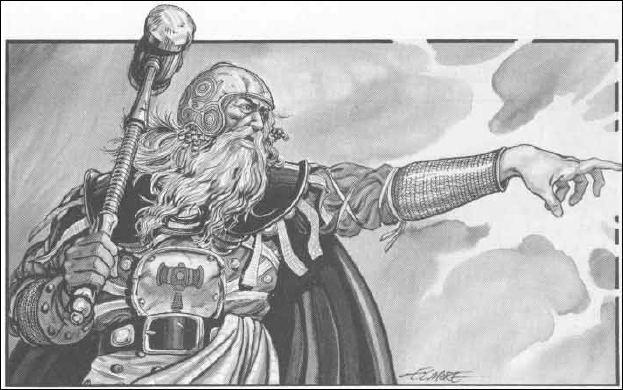
So... this brings me to my absolute favorite PC class.  CLERIC.  Why Cleric?  Well, because of the Elmore artwork in the Expert Set book, initially.  MAN those Clerics rocked.  Also, Aleena, the Cleric from your first adventure in the D&D Basic Set.  But seriously, take a look at the Cleric.  Wear any armor.  Use any blunt weapon- warhammers and maces rule.  Now, gain the ability to make undead creatures run from your holy rebuke.  Now, on top of that, add the ability to cast spells that heal and protect, and even a few with offensive capabilities.  WOW!  That makes for a powerhouse class that amazingly fun to play.  You can play the character like the Paladin, just minus the sword.  You can play a jolly, Friar Tuck-style Cleric.  You can play a vengeful Cleric of an immortal of War, there's so many ways to play a Cleric.  All of them, however, are able to mix it up in melee *and* use clerical abilities to defeat undead and heal their allies.  Most D&D parties would never leave town without a Cleric.  Sure, the Elf can fight and cast- but he can't heal.  The only source of magical healing beneath 9th level in BECMI is the Cleric, and it was and remains my favorite D&D character class.

26 June 2015

D&D 30-Day Challenge: Day 2 - Favorite PC Race

Favorite PC Race.  Well, I'm afraid my answer for this one is going to be fairly boring - Human.  That said, I've played all the classic PC races from the BECMI Dungeons & Dragons game, as well as a few from AD&D or newer editions that weren't canonical or playable back in the old days.  I guess I should elaborate a bit, since just the bare answer wouldn't make for very interesting reading.

So, when I got into D&D, there were really only four PC races to choose from, and in that case race as class was a thing.  For those who don't remember this time long ago, what that means is that Humans could choose a class- Cleric, Fighter, Magic-User or Thief.  Demi-Humans, that is Dwarves, Elves and Haflings treated their race as their class.  There were no Dwarven Clerics or Halfling Thieves in the BECMI rulebooks.  Now, such things would be added later by the Gazetteer series and already existed in Advanced D&D, but we're talking about the game I played when I started playing D&D - and that's the Mentzer BECMI rules.  BECMI stands for Basic, Expert, Companion, Master, Immortal.  These were the five boxed sets that made up the whole of the rules for this "edition" of Dungeons and Dragons.

So... as a Human, you could play the four classes.  If you chose Demi-Human, you were what the rest of the adventurers of your race were.  Demi-Human classes were kind of paragons of what it was to be that particular race.

Dwarves were fighters with much better Saving Throws and some pretty neat abilities.  Dwarves could see in the dark.  It was called Infravision in those days, and I still call it that now out of stubborn grognard habit.  So, Dwarves saw heat out to 60', allowing them to function in the dark.  They also spoke dwarf, gnome, goblin and kobold in addition to Common and their alignment language.  They could detect stone traps, slopes, new construction and other details about stonework.  You know, Dwarf stuff.  Back in the 80s we did not yet have the Scottish Dwarf stereotype, but the rest of the Dwarf stereotype was already alive and well.  I enjoy playing Dwarves, they are hardy and their abilities give some good RP fodder, though they tend to be very Tolkien Dwarf- which is a feature, not a bug, if you grew up playing like I did.  Lots of fun, but not my favorite.

Elves were basically Fighter/Magic-Users.  The orignal Elf in the 1974 rules had to choose whether to function as a Fighting Man or a Magic-User each day, and could only use the abilities of one or the other during that day.  The Elf of BECMI D&D did both of them at once!  Your Elf could wear plate armor and cast Magic Missiles!  Elves had less hit points than Fighters, and required more experience points than any other class to make levels, but they were amazingly versatile.  On top of being able to use any weapon or armor and cast Magic-User spells, elves also had Infravision, extra languages, and could detect secret or hidden doors of any type 1/3 of the time.  Oh, and they were immune to being paralyzed by ghouls.  Lots of fun, Elves.  A very do-everything class, but the XP toll was heavy.  Enjoyable, but again, not my favorite.

Halflings.  I feel like the BECMI Halfling is overlooked a lot.  Oh, and I have it from Frank Mentzer himself that they're HOBBITS, damnit.  Anyway, these little guys have the most incredible Saving Throw progression in the game, they have an AC bonus versus large creatures, the natural ability to hide nearly perfectly out of doors and fairly well indoors.  They also get a bonus on individual initiative and on missile attacks.  There's a lot of great abilities here, and a lot of play value in creating a Half- er, Hobbit PC.  A very, very entertaining choice and a surprisingly hardy little character- but not my favorite.

I have to go with plain old boring Humans.  Why?  Well, most of my PCs are human because I identify most readily with humans and, as my current PC Linhardt of Quasqueton proves, I like an underdog.  Humans (in most game worlds) are forging their own way in a world populated by races that can see in the dark, or are naturally magical, or have skills Humans lack, and still the Humans prevail on sheer will and Chutzpah.  As a Human I can play my favorite character class- to be revealed in the next post.  Humans tend to get along with all the other PC races, where some of the PC races don't always like each other in many game worlds.  I enjoy the familiarity, yet versatility of the bog-standard Human.  May not have Infravision, or an AC bonus, or know jack about stonework- but my favorite PC race.

25 June 2015

D&D 30-Day Challenge: Day 1 - How you got started.

So, I see this thing on Facebook about the Dungeons and Dragons 30 Day Challenge. Looks kind of interesting.

I've been a gamer since the summer of 1986.  That's 75% of my mortal existence at the time of this writing.  It's the hobby and interest that defines me, right down to things I love to do with my kids and the subject matter of the Masters Thesis I am currently writing for my MA in Military History.  Maybe it would be an interesting exercise to go through the D&D Thirty-Day Challenge for my own reminisces as well as the enjoyment of anyone out there in Internet Land who would find it of interest.

In 1985 I was 10 years old and had just relocated from Round Rock, Texas to Temple Terrace, Florida.  My mother was looking for a fresh start, and we pulled up stakes and and went to Florida where her sister Carrie and her husband and their newborn were living.  My uncle Gerry was a programmer at IBM and a audiophile with a taste for the Beatles, and my cousin Kenny a tiny spud of a baby who was vaguely amusing to me.  I was terribly put off by the move- all my friends were being left behind, I didn't know anyone, it wasn't even my state.  My sole consolation upon arriving was to find that my favorite cartoon that I'd only seen aired in my grandparent's market in Lake Charles, LA also aired here - Tranzor Z.  Our first day in Florida, I tuned in.  As Tranzor Z ended I was fascinated by this other show I had never heard of - Robotech.  The episode I saw first was one of the final "New Generation" storylines of the 85-episode series, in which Scott Bernard and his Freedom Fighters find the city of Denver preserved beneath ice.  I couldn't take my eyes off it. 

The year we spent in Florida reinforced some things I already loved - GI Joe, Transformers, Voltron - and introduced me to some new things - Robotech, MASK, and my first glimpse of Advenced Dungeons & Dragons.  Although I cut my teeth on Mentzer D&D Basic, the first books I ever paged through belonged to the older brother of a school friend named Eric who lived across the apartment complex from us.  He had the AD&D core books in his room, and I was immediately fascinated by them.  I had heard of D&D of course, most kids my age had.  We watched the D&D cartoon, and some even had a few of the LJN D&D action figures like Strongheart, Warduke or Peralay.  There were a couple of D&D carts for the Intellivision... but books?  What could they be for?  Sadly, Eric's brother and his friends were about as enthusiastic about showing us as Elliot's brother Michael's friends in E.T.  You can't just join any universe in the middle.  I had to content myself with my other interests, like my Vectrex and Transformers, until we moved back to Round Rock the following summer.

Returning to Round Rock was something of a sort-of victory for me.  I was home, back in the town I considered my hometown- it was where my mom's parents lived with some of my aunts and uncles, and the town where I had the most memories and roots.  Mom and I had moved there the first time in 1982 after I completed the first grade in Humble, TX.  I made a lot of good friends at Robertson Elementary from '82-'85, and I was looking very forward to picking those friendships back up when we got back to Round Rock... only we moved to the other side of IH-35 and I ended up at Chisholm Trail Middle School instead of C.D. Fulkes, where everyone I knew went.  I was back to being the new kid with no friends.  This kinda sucked.

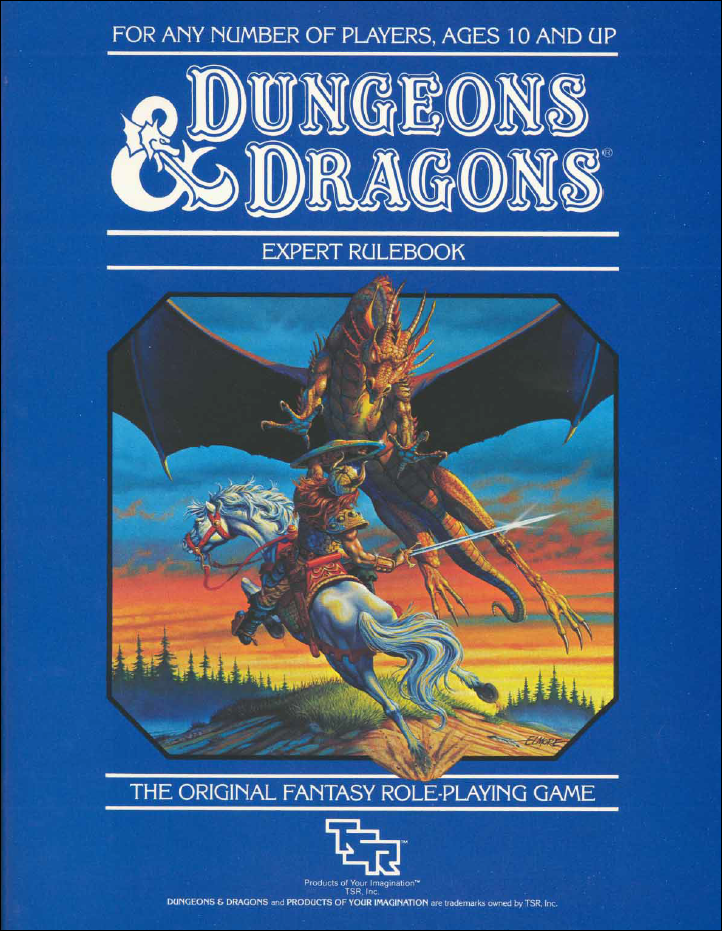
Almost immediately, I met Daniel Varner.  Daniel was a fellow science fiction nerd, and had to wear a brace that kept his knees apart by about a foot, making his locomotion a Cowboy-like gait where one leg swung forward followed by the other.  In Boy Scouts he picked up the nickname "Jock Itch" for this particular factor.  Daniel and I became fast friends, and he invited me over to his home to hang out after we met at the park just off Chisholm Valley Drive that would later become the second incarnation of Drakenroc, my Amtgard LARP park.  Along with Jim "Cookie" Cook and a few others, we delved into the realm of Dungeons and Dragons for the first time during the summer of 1986.  Daniel had the Mentzer Basic and Expert rule sets, and he started all of us with our first characters at 4th or 5th level.  I remember opening the D&D Expert Rulebook, the blue one with the mounted fighter charging the dragon, for the first time.  The illustrations are what pulled me in immediately.
 
I will always owe a debt of deep gratitude to Larry Elmore, who I had the chance to meet recently, for the art that set the hook, and to Frank Mentzer, who I also got to game with earlier this month, for penning the version of D&D that remains my favorite to this day.  Two illustrations in particular remain so vivid in my mind that I can close my eyes and recall them in detail even today.  The first was of a Cleric casting what I assume was the Speak With Dead spell, the second was the class illustration for the Cleric class itself a few pages earlier.  I guess the book must have opened to the spell descriptions.  This book had me enthralled in a way only possible before by books on things like UFOs and the Loch Ness Monster.  I loved reading about the strange and the paranormal.  I loved reading The Hobbit.  This was somehow a book you could... play?  And thus my first, short-lived character, a Cleric, was rolled up.  With the toss of that first 3d6 (in order) a journey began that has not yet ended and God willing won't for many years to come.  It is a journey that has been shared with countless friends along the way as well as my wife and my son- and soon, my daughter, when she's a bit older.  The collaborative storytelling that is the Roleplaying Game soon captured my imagination like nothing before had, and I found myself turning to reading even more as a favored pastime.  I devoured books from the CTMS library and Round Rock Public Library on everything from mythology to the middle ages to ghosts to spacecraft.  I discovered that Conan was more than an Arnold Schwarzenegger film.  D&D soon led me to Marvel Superheroes, Star Frontiers, and Gamma World.  My mom's co-workers at Eaton found out I was gaming, and gifted me with Traveller, Cyberpunk 2013 (brand new!) and 2300 AD books.  I scraped together my own money and purchased the first RPG I ever bought for myself just after my birthday in 1987- Palladium's Robotech RPG and a set of red Koplow dice in the extended tube that came with 3d6 and 2d10.  Then came Palladium Fantasy, GURPs, Paranoia, Star Wars D6, FASA Star Trek, Call of Cthulhu, Elfquest and Pendragon- all before I was a High School Freshman.

Gaming became such an important part of our lives that it was the bulk of our scouting weekends.  Much to our scoutmasters dismay, we'd rush to set  up camp and get dinner on the fire so we could break out the D&D or Traveller books and have adventures.  We even played a mini-campaign at Lost Pines Scout Camp, and somewhere out there my second Cleric, Brother Maynard, is still running...  Daniel's group played every day after school for all of middle school when we could, and most Saturdays.  We were kids, with munchkin tendencies, and I got my second character, a Magic-User, into the high 20s level-wise before he was killed by the black dragon we had managed to subdue...  while strapping on its feed-bag.  What do you want, we were 13?

Dungeons and Dragons and other RPGs gave us misfits a place to fit.  When we weren't athletes or popular folks we could always sit down at a kitchen table with others of our kind and toss dice, creating stories together that were just as good as any book or movie.  We could cease to be middle school students and be great warriors, mages, clerics or thieves.  Movers and shakers in the Known World, delving dungeons from which lesser mortals never returned.  And that made for a childhood that was completely badass.

I can honestly say thanks to this hobby I read more, I learned more math - any Traveller player who wanted to calculate interplanetary journey time had to know how to square root things - I devoured knowledge in all its forms and learned creativity and problem-solving.  I learned people skills, how to improvise dialogue and voices, how to plan for contingencies...  I wouldn't trade it for any other childhood.  I grew up in the 80s, we had D&D, great cartoons, great video games and the best music ever.

My mug is raised to Gary and Dave for giving us the game, Frank and Larry for making it something that immediately grabbed me and pulled me in, and especially to Daniel Varner, wherever you are, for handing me my first D20.  Cheers, guys.  And as I have done so much in the past, I will continue to spread the game and hopefully the love of the game as long as I'm able.